
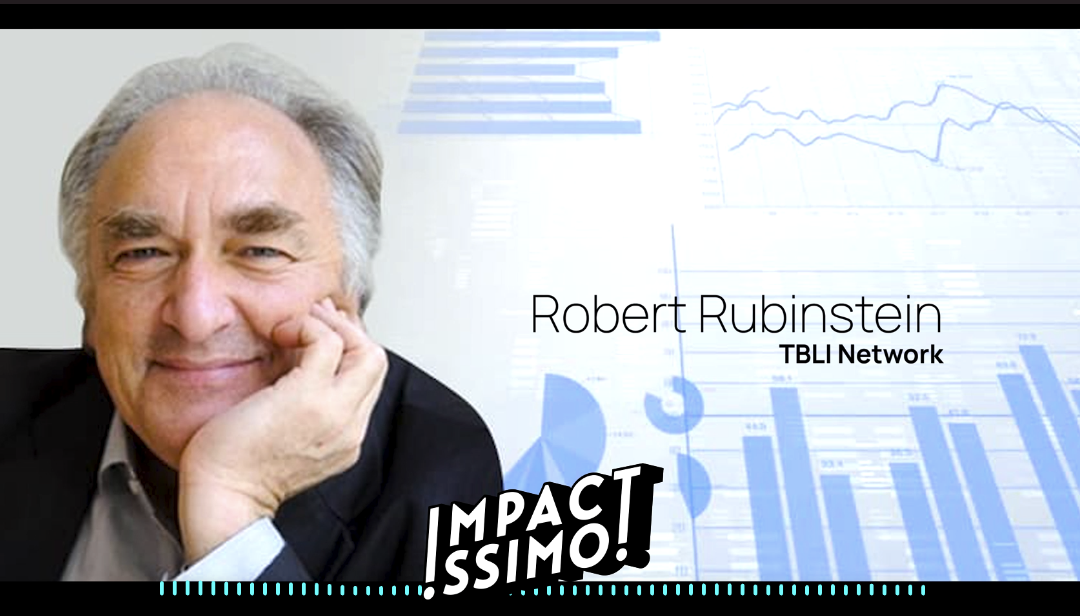
iMPACTiSSiMO! Podcast Episode 61: Robert Rubinstein founder of TBLI
His blunt assessment: Sustainability has become a gym membership card that everyone shows off but nobody actually uses. The big events, the selfies, the keynote speeches – none of it is moving the needle. What actually works is long-term farming, not hunting. Singles and doubles, not home runs. Grabbing the shovel and doing the work.
Robert founded TBLI Group in 1996, before ESG was a buzzword, before impact investing was a thing. Three decades later, he’s still beating the same drum. He’s built a community of impact misfits who actually want to see a financial system that works for all.
He’s got a book coming out called “Radical Truth” – and he’s not pulling any punches. It’s aimed squarely at the financial system and the business schools that keep feeding it.
He’s actively looking for:
- Family offices and asset owners who are serious about sustainability, not just talking about it
- Companies restoring the social and environmental balance with simple, honest approaches
- Non-extractive, purpose-driven people ready to do the work, not just join the club
If you’ve ever sat in an impact conference and felt tired of the empty promises, Robert’s message will resonate with you.
Podcast Transcript
Jacob: I’m here with my good friend Robert Rubenstein with Triple Bottom Line Investing. We’ve curated a community of people that actually walk the talk.
Posers don’t tend to stick around. Wherever I travel in the world, I’ll reach out to you and to say who are the good people I should meet? You always have somebody that’s genuine. Kudos to you for taking the long-term view of building community, that’s what I feel like we need so much more of as opposed to just extracting from people.
You’ve invested in a lot of people to build them up and just honored to call you a friend and grateful for your mentorship and influence.
Robert: That’s very kind of you to say that you are, you’re also one of the few authentic eccentrics that is non extractive, so actually understand there’s abundance, let’s share.
So I’ve always admired that and, um, but we’re, you know, we’re a [00:01:00] fine wine, like you, it’s not for everybody most people like Coke. Thank you for those kind words. And I look forward to connecting you with many other brilliant people and that we have lots of fun, you know, making the financial system work for everyone.
Jacob: I’m curious, you know, what got you on this path of impact, from, you know, an illustrious career in oil drilling or whatever?
Robert: Yeah, I mean, well from working on oil rigs and in Iran and the North Sea and Tex-ass. I did a lot of different things and, then I got into publishing, I started a successful Bicycle magazine and that ultimately led me to Management Magazine on [00:02:00] sustainability in 95.
But that didn’t work out. The bicycle magazine was a financial and spiritual success and the management magazine only a spiritual success and financial disaster. And, I still wanted to create an economy based upon wellbeing, and I figured I had to convince the financial sector because they had great power and the wealth concentration in the small hands. I needed to convince them that sustainability wasn’t their interest.
So I was always purpose driven. Maybe ’cause for my parents always trying to do what’s right and that the present economic system, this way working particularly in finance, didn’t seem, in the interest of society or the environment. That’s why I started TBLI, to help educate those asset [00:03:00] owners and hopefully change their mindset and the behavior around sustainability.
So that’s always been the purpose. And fortunately, as you know or don’t, there is no group more predictable than the financial sector. It’s just a bunch of overpaid alpha males who run up the hill and jump off the cliff at the same time. So it was not hard in getting behavioral change doing all of our International summits, the challenge was access. The more money someone had, the more isolated. So that was the whole idea. It’s very simple, but it’s very long-term farming. It’s not hunting. It’s no magic bullet. Oh, if I do that, I’m going to get $50 trillion going in this direction. It’s grabbing the shovel and digging the hole and doing the work, which is why most people don’t wanna bother doing that. It takes a long, long time. Even the ones that [00:04:00] are super well connected. Well, like, um, Milken, not, not, not Milken, uh, Milken. Milken, you know, with his big event. He doesn’t really move the needle of the World Economic Forum with all of the influences. Davos in the desert, same thing. So, because most people in the financial sector are comfortable with the present situation, why change it?
Why bother?
Jacob: So I mean TBLI has had some differences, um, it’s evolved over those 25 years, you know, and even from, you know, in-person events and larger summits, and maybe just walk me through that evolution and where is it now and what are you focusing on now?
Robert: We just want to work with non-extractive, generous people, [00:05:00] and there are plenty of them, a lot in our network, and you’re definitely at the top of, the top of the list. It’s just what frustrates me is that in 25 years, I’ve never said anything different than I said 25 years ago. It’s just, it’s frustrating that it’s taking so long to get through, fundamentally.
There’s still a lot of interest and impact investing and sustainability has turned into a membership card to a fitness club and showing everyone you have the membership card, but you never go and actually do the exercise on the machines, but you’re showing everybody you’ve got the membership card and that needs to stop. That really needs to stop. That’s beyond greenwashing.
Now when we started, there weren’t any major events around ESG at the time it was SRI, social [00:06:00] Responsible Investing and we were one of the first to do large events, you know, in Europe, in Asia, Latin America, and North America. Obviously we got hurt badly when the financial crisis hit and had to really downsize a lot, but figure out a way of keeping the lights on and keeping the outreach going, and continuing the educational outreach. Then when COVID hit, we had to, you know, retool ourselves again because we couldn’t travel and had to do everything virtually. So, virtual masterclasses, podcasts, investor salons, mixers, so everything around continuing that capacity, building.
And we also did private dinners for small groups, we did retreats. We tried many, many things that [00:07:00] would help in allowing people to better understand that we’re not talking about sacrifice, we’re talking about resilience. But it always was very, very hard because the only way really to make significant revenue is you have to lie.
You gotta say, oh, Jacob, gimme $30,000,, $40,000 and I’m gonna put you in front of a hundred family offices who all are billionaires or multimillionaires, and you foolishly do that and everybody you meet is asking you for money. And you don’t meet all of those asset owners.
Or you spend a fortune sponsoring a very big event, no critical thought because we don’t wanna upset the sponsors. So you don’t really learn anything and everybody’s busy taking selfies with you, but they never [00:08:00] answer your call when you follow up with them. So it’s hard because everybody wants to be part of, you know, the club and wanna be part of the party because the herd is moving in the direction of sustainability and impact. And there are very few who are asking Jacob, how can I waste more money? How can I burn more fossil fuels? How can you know they’re not, or how can I produce more CO2? They’re not talking like that.
So it’s just not moving as quickly as we would like. We have to retool the whole economy and that takes a while and there are a lot of people who might lose, you know, the fossil fuel industry, et cetera. So too, most people want the big annual event where you get lots of excitement, but then nothing happens after that because people [00:09:00] don’t respond. And it’s about, it’s about singles and doubles. It’s not about home runs and grand slams and too many in the industry are searching for the home runs and the grand slam to put it in baseball terms. But it’s long-term farming, it’s not hunting. And we’re working with this sector, the financial sector, that are hunters. And some are pirates, but in general they’re incentivized for short term behavior. And you’re talking about slowly, you know, doing the work, get the seeds to come up when they’re ready.
You can’t microwave that. So, everyone is kind of busy, being busy, and not enough people wanna do the work or share, [00:10:00] or it’s just about extraction. And that can get quite depressing and very few people will, are willing to talk like the guy behind me, George Carlin, and say, sorry Jacob, but your children are quite ugly. What you’re doing is not really special.
And I see it all the time, even though I know the people, and they’re not stupid, but they’re in, they’re in a member organization, so they don’t want to piss off the members and that, and we need more radical truth. We need more critical thought, not less. And we need to say, you know, sorry, but it’s not really, you’re not really getting anywhere.
So it’s still the same work, it’s still grabbing the shovel, digging the hole, doing the work on with, and be happy with little wins, small wins. A big [00:11:00] win, you know, that’s, that probably won’t happen in my life. So who knows, maybe my book will be very popular. We’ll see.
Jacob: Yeah. So tell me about the book and what was the impetus for that, because I know, I mean that sort of, you’ve been the George Carlin of impact in the sense of speaking the radical truth or the, you know, what people need to hear but don’t wanna hear. But yeah, tell me about what sparked the book and when it’s coming out and all the details.
Robert: I was always a fan of George Carlin. My fam, you know, Ricky and my wife and son, always very big fans because he was, he didn’t try to embarrass someone, you know, like Don Rickles did, or just insult that he was very critical of the entire system, and he saw clearly how it doesn’t function, wrapped in a nice bow that it looks like it does [00:12:00] function.
So that was a great inspiration and then having done, you know, 40 international summits and having dealt with the financial sector at the highest level from highest private banks, wealth managers, pension funds, insurance companies, endowments, high net worth. And seeing how that system, and even business schools, I taught at a ranked MBA school and starting to see, wow, this is just like incredible ammunition for someone like George Carlin.
So I put together, you know, an outline of what should I be covering, you know, wealth management, industry, the asset management, the consultants, the strategy consultants, the business schools, the impact networks, you know. All the government, all everything that impacts how that financial system works and kind of write it in an [00:13:00] irreverent George Carlin style to expose why our financial systems, and educational system, particularly business schools, are basically, literally burning down the planet for profit. But at the same time how we can turn it around. It’s not just saying, okay, everything’s terrible, let’s give up.
No, first understand that, what the present system is doing, how it’s not functioning for, except for a few and that we need to be critical of that. The downside of that is, it doesn’t make you popular because we won’t get invited to the, big events to give a keynote speech because they don’t want us to say what we’re saying.
So I’m hoping that the book can reach a large group through eBooks and printed. I was [00:14:00] gonna try to get a publisher, but I found out that they’re only interested in brand names that have already large following, so we’ll, you know, self-publish. Uh, it’s called Radical Truth and hopefully it will wake people up. That they can see that it’s possible to turn this around, it’s not that, it’s not that impossible, you know, to do, it doesn’t have to be like that.
Jacob: Nice. So when, when does it come out? When does the book come out?
Robert: Uh, good question! My brother’s been editing. I was nearly done and then he said, you know, you should add to each chapter how TBLI influenced [00:15:00] that change. So I started looking at that, Hey, wait a minute that Flash Boys, that book that Michael Lewis wrote. We were the first to invite the guy who developed that whole ethical management, fund management system to stop the algorithm and high speed trading. I forgot about it. So I started looking at all of the things we had done from interviews or events or that, so I started adding that to the last of each chapter.
And that was okay and then my brother said this is getting a bit boring, you gotta start looking at that again. So I have to go through that. I had written all the chapters, but I need to go through that last part, you know, ’cause we were really early on so many levels. I mean, I was amazed when we started in [00:16:00] ’97, ’96 and some of the thing, the people that we brought in there, the head of UBS. So, I still have a little bit of, I hope to be able to publish this, Q4. Hopefully I still have other things to do, but hopefully then.
Jacob: I mean, there’s no shortage of things to spare about or get frustrated with in the world today so, I mean, where do you see hope? Where do you see the positive things?
Robert: The mayor election in New York. Um, you know, in spite of the fact that, you know, people want to phrase him as a Hamas supporter, I’m very encouraged by an intelligent, articulate, communicator, like Mamdani, that out of nowhere, just from 75,000 volunteers. And then the no [00:17:00] Kings Movement, and people in the military leaving because they don’t support this particular President, the amount of money going into biodiversity, into fuel free, into you know, true innovation and many, many, many social entrepreneurs, going in that direction.
So I see lots of inspiring things. You don’t need a lot of people to make fundamental change. And I’m glad there’s a little bit more critical thought and pushback about the way the direction of ESG has gone, which is why we did the Better World Prize. So, I am, I’m a bit concerned in the short term, you know, Trump will never fail to fail. He will [00:18:00] fail. He’ll crash and burn and he’ll take a lot of families with him. You know, farmers, ranchers, electricians, you know, many, the billionaires will be fine, they’ll manage. But at the same time, you see lots and lots of people pushing back, people from the media creating new media to stop this craziness, this concentration of wealth.
So, I am concerned in the short term, I’m optimistic in the long term, but we will have a very difficult time with relation to climate change and storms and damage and that, that will be hard.
We, you know, basically ,mitigation, I don’t think we’re gonna be able to do it in time and it’ll be much more about [00:19:00] adaptation and most people are looking for a tribe. In one way or another, they’re looking for a place where they can be themselves and pursue their big purpose, but many are. There’s still a lot who are just frightened. I’m also very encouraged that many people with talent will leave large institutions once they realize this is not where I need to be. Like you did many years ago, staying and doing the same old crap that you were doing by profiting and facilitating environmental social destruction is not gonna put a smile on your face.
Jacob: Yeah. So what are the allies that you need most right now? If we were to connect you with the right fit, kinda people that you are most looking for. What do some of those allies look like? [00:20:00]
Robert: Companies for family offices that are serious about truly embracing sustainability asset owners that are looking really to do something, not just chat about it. Companies that are busy restoring the social environmental balance in a simple to understand technology, not you know, these climate tech sucking CO2 out of the air, these nonsense organizations like that. That’s fraud.
So organizations that are serious about pursuing their big purpose, being non extractive, being generous, and if they’re in a position of power, whether through wealth or through a network, or through a company that they’re setting, those are the people we, you know, we want to engage with [00:21:00] and help them. And often it’s as simple as connecting them with someone that can get them a bit further. I always used to think all these wealthy people must have each other on speed dial, and they don’t, they don’t, sometimes they’re working and are living in the same building and they never speak.So just people that are pursuing their big purpose, non extractive, generous, who want to restore the social environmental balance and not that complex,
Jacob: Robert, appreciate the ’cause that you do in the spotlight and maybe like the Forest Gump of like starting all these things and being woven into the history of so much that’s happened in impact.
Robert: It’s a very kind overview, but there are a lot of people doing things in silence. The ones doing the [00:22:00] most, they talk the least.
Learn more about ISSIMO Story Agency Here