
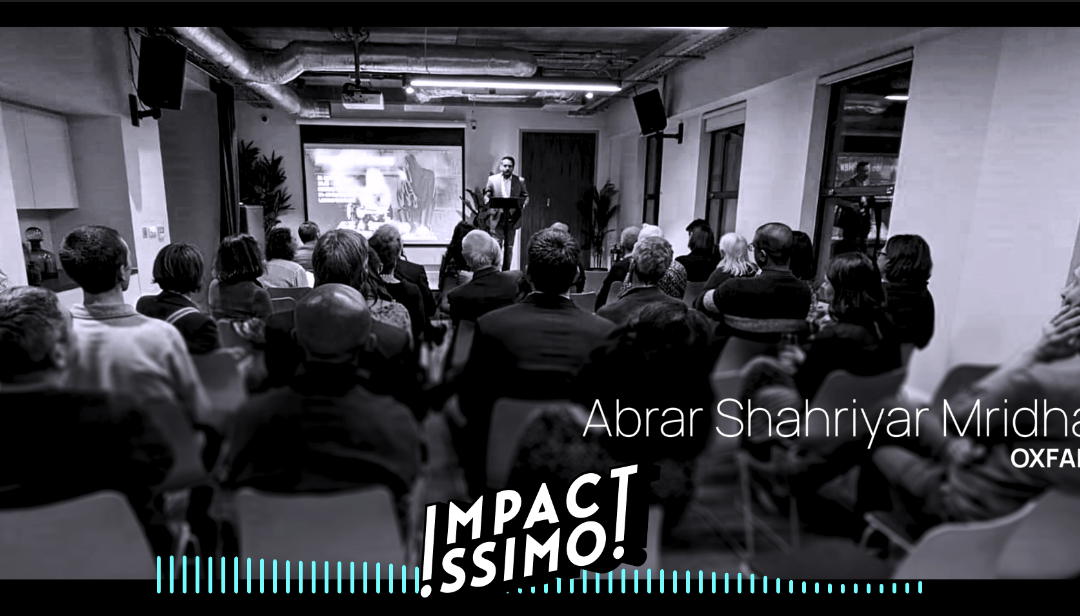
iMPACTiSSiMO! Podcast Episode 59: Abrar Shahriyar Mridha with OxFam
“There’s no shortage of capital in the world. The shortage is in the will to direct it toward where it’s needed most.”
Most investors see emerging markets as too risky. Abrar Mridha sees the opposite problem: capital flowing in the wrong direction.
As lead of Oxfam UK’s enterprise development program, Oxfam fights poverty and inequality by deploying catalytic financing and enterprise development to create lasting opportunities for the world’s most marginalized communities.
Abrar has watched women in Ethiopia go from unemployment to running businesses, sending their kids to school, and inspiring entire communities to follow. He’s seen firsthand how one investment creates a chain reaction.
In this episode, he breaks down how blended finance can make impact and returns work together, not one or the other.
Allies he’s looking for:
- Pipeline partners who can connect him with the right entrepreneurs on the ground
- Technical assistance partners like INGOs, incubators, and accelerators who can share the load of capacity building
- Capital partners like impact investors, family offices, foundations, and DFIs who can co-match funds and help scale guarantee-based financing
If any of that sounds like you, this episode is your invitation to reach out.
Tag someone building in this space. The ecosystem only works if we build it together.
Podcast Transcript
Jacob: [00:00:00] I’m here with Abrar with Oxfam. What I’d love to learn more about is sustainable development, particularly blended finance in a variety of regions, particularly through a kind of the Oxfam model. What you see are the next big hurdles, and how, as a community, can we help you better accomplish the good that you’re trying to do in the world? So with that, welcome.
Abrar: Thank you so much for having me on this podcast, Jacob, and it was really a pleasure to connect with you. First of all, I often say in different places I go, the people I meet, I often say that finance, when used fully, can actually transform communities and spark sustainable change. And my journey started basically working in the private sector, building brands and strategies for global brands, specifically in Bangladesh, but I wanted to do [00:01:00] more to grow businesses.
And I wanted to grow opportunities for people who have historically left behind. And that, that’s where I came to what I do actually right now in Oxfam, which I lead Oxfam UK’s Enterprise Development Program, which is a multi-country program. Based out of Asia, Africa, and Latin America, where we deploy catalytic and blended financing to invest in small and bigger macro enterprises.
These are not just businesses, as you can understand. These are, for us, engines of social change, creating jobs. Specifically, this program is very much focused on empowering women and also building being quite resilient in communities that need it the most. And that is where my passion lies, specifically building ecosystems where capital becomes a true force for good.
And I’m absolutely excited to share what I’ve learned and what possible things can happen when finance meets things for purpose.
Jacob: It’s easy, especially the, you know, in finance, there’s a lot of jargon [00:02:00], and there’s a lot of different things. And, if you were to try to explain what you do to a 6-year-old, what Oxfam model, like how do you actually help these small businesses succeed, and what is what makes you different than other organizations out there doing, trying to do similar things?
Abrar: Absolutely. So first of all, we support enterprises that have a very specific focus on women. It’s all just about women’s empowerment, but in every aspect of the value chain, and the organization, through their work, through the products or services that they sell, there is an engagement of women being in, coming into a leadership position, or I would say transforming into a leadership position.
And, so we do support in two different ways, that’s why we call it a blended financing model. So we do a technical assistance, which is basically capacity development, mentoring, and working. Giving them access to financials in different capital markets. And then we [00:03:00] do a guarantee-based, prepaid financing model, which is partnering with DFIs and banks in the countries across Asia, Africa, and Latin America.
So it’s also a localized approach, which we use to work with global partners, making it much more sustainable. And that’s how this capital revolves back into their work. And that’s what I said when a woman-led enterprise grows, it not only supports that group of the company, but it does support the entire community that it works in.
Children start going to school, and finances become stable for the families. Local economies become more inclusive. You would see organizations like Oxfam and other NGOs focusing a lot on advocacy and influence. And we also believe that things like catalytic capital can also bring a lot of change in sustaining these inequalities and moving these changes much faster, and you have seen [00:04:00] that sometimes advocacy and things take a lot of time. And, I personally, come with backgrounds and work experiences in multiple regions in financing different innovative solutions has worked much faster at the ground level. I’ve seen real-time changes where Jeff was mentioning women getting a lot of leverage in different societies, which they didn’t use to get before. So I think that’s a big change that’s happening from time to time. These are innovative solutions that are not only done by Oxfam, these are done also by other organizations. As you may already know, other INGOs integrators, accelerators, and back fund managers.
So I wouldn’t say we are doing something exceptionally unique, but we are part of the change of the ecosystem. So we do partner with a lot of collaborators across the ecosystem, and that’s where we try to leverage the force for good.
Jacob: And give me some case studies or success [00:05:00] stories about the work that you’re doing.
Abrar: A very interesting partner that came with us to support an enterprise in Ethiopia, which is called AndeMamma. Where we have a lot of mothers who didn’t have any work, and they had a lot of negative social changes in their lives. And that has not only impacted them, but their children, the community, their social status, and their economic status. So what they basically do is they recycle different plastics, and then they make a very innovative product out of it. And then they sell it to the community in different shop outlets, different restaurants. It’s not just empowering the mothers but also making them feel much more recognized again.
They are also becoming a part of society, which they were not very strongly a part of. They’re economically benefiting from it. Some real-time changes would be: Their children were not going to school at all, but now they have started going. [00:06:00] They are networking with people that they have never thought of: governments, universities. They’re coming into social media channels, they’re talking, they’re giving interviews, not something that they’re absolutely used to, but these kinds of things change a lot of people’s mindsets.
I was in Ethiopia last year, and one of the women I was talking to was saying that some of this, some of her relatives actually became very happy to see such changes happen in her life. And she got motivated, and she started something of herself, not the same business parts, but it’s a different business. Did you see the chain of impact that happens if you support one, even one person, one individual, and that could empower or motivate someone else? And then it acts as a chain in the community, and who knows?
Jacob: Yeah. So I mean, helping that one does have a chain reaction or ripple effect.
Also, paint for me a picture of the [00:07:00] scope of what Oxfam is doing. There’s that one woman in Ethiopia who was helped, but how many like her are out there? Or is it a number of people or the amount of capital mobilized, or how do you measure the level of impact that you’re making? Paint a picture of that for me.
Abrar: We do have key impact metrics that we use to measure, specifically at the general level and then at the fund level. Until now, we have supported, for example, over 40 enterprises across Asia, Africa, and Latin America. This is something that has helped us to give jobs to approximately 20,000 people, indirectly. And then there are approximately 1,500 women who have been involved across value chains, across the organizations who have just got new jobs around here. We can also say that there are also, indirectly, a lot of people, including children and the public community, have been impacted. We did research, and we [00:08:00] saw that somewhere around 100,000 people got indirectly impacted through all work.
So these are just broad numbers, but in terms of investment, we have given around 4 to 5 million in terms of recyclable capital that has gone through as loans to enterprises that have come back. We have a very low default rate. There are always challenges in the emerging context and the communities that we work in, but we still need that kind of space where traditional development models, aid, and grants can go only so far. So to tackle these challenges of climate change, gender inequality, and economic exclusion, we need private capital to step in more and more, but more in the short-term, profit-driven way. And that’s where we talk about more impact investments and then the financing as game changers, because they align the financial sustainability with the measurable social and environmental impact.
So NGOs like Oxfam are uniquely positioned to these [00:09:00] investments, build ecosystems, which we are trying to do as a matter and ensure capital, which is that those enterprises that truly can transform their lives.
Jacob: You mentioned some misconceptions that investors might have. What do you see as the biggest hurdles that you have to overcome in terms of their biases or expectations, versus what the reality is?
Abrar: So, impact is a long game. It takes patience. It takes time in order to get a very strong partnership and get rewarded out of it; it takes time. An innovative structure to align institutional expectations with on-the-ground realities takes time; being patient about it. And that’s why you will see a lot being talked about, even in terms of, so you will see a lot of synonyms coming out of impact investments, blended financing, and you see people talking about patient capital. That is why it comes across that investors do see emerging markets as high risk, but the truth is the risk is not investing because the cost of [00:10:00] inaction on climate and equality is far greater.
So we need more catalytic, concessional capital to unlock private investments and prove that impact and returns can go hand in hand. There are lower default rates. There are investments that are weighing much more than we even anticipated. So being able to communicate that in a much more structured way gives investors the confidence and the flexibility. It talked about a bit of a mindset. Traditionally, NGOs used to invest in enterprises only through the traditional model of grants, and that has changed a lot of enterprises’ mindset about only taking money as free capital.
And when they wanted to scale up, or we wanted them to scale up into different alternative financing models, they always became a challenge, because they’re used to something which is very free. And that’s why I think allies are very important. You are not able to do everything on your own. Oxfam will not be able to do everything on its own.
I say we are more like an ecosystem player, so we need more impact [00:11:00] investors, development, financial institutions, family offices, foundations, who are willing to take the first step to catalytic capital. We also need ecosystem players, like accelerators, policy makers, academia, because this isn’t about one fund or one program. It’s about building an entire system where impact and finance can reinforce each other.
Jacob: Well said. So in that ecosystem, what’s the biggest constraint or the biggest hurdle you face right now?
Abrar: I think being able to understand who is doing what, in what capacity.
There are so many partners that work in different sectors, and at the end of the day, finance is not just about numbers; it’s about people. So understanding people, understanding the organization, what their vision is, tagging along with them, trying to build an ecosystem, is very important.
For example, I’ve started something in Oxfam which is called Oxfam’s Social Innovation and Incubation Lab, which is basically trying to partner with [00:12:00] universities to get the university students turn ideas into reality with some seed money, but we don’t take it to scale. We work with different partners, for example, incubators who actually turn into maybe an accelerator who try and support these individuals, which we have supported. Oxfam starts supporting everything, or a fund manager starts supporting everything, but it doesn’t bring the entire ecosystem to support that particular individual who doesn’t have that access in the rural universities to start going big. So it’s all about that.
First of all, trust is very important. Changing those mindsets is very important. It’s very, very tough. And if we can direct capital to those solving the world’s hardest problems. We don’t just build businesses; we need to understand that we build futures; futures for the next generation; futures for us to live on a better planet. And, I think that’s the work I’m connected to, and I even invite anyone listening to join this [00:13:00] journey, connect with us, and make this capital through your force for good.
Jacob: What are the allies you most need right now? The most crucial allies in this moment for Oxfam?
Abrar: So one is, so we do keep on building pipelines in every country that we work with. Being able to find partners who can support us in getting the right entrepreneurs for us to support, because we don’t support like a normal incubator or accelerator for a small period of time. When we come in, we come in for a longer period of time, and that’s why we call it a much more systematic shift.
We also support it, so there they have a policy issue. For example, there is a safe food chain problem. For example, in Bangladesh, there is no specific policy for safe food. So we do work with the partner that we have supported in trying to advocate for safe food policy. So in those cases, we do also need partners who can support us even in advocating or influencing the governments. We need partners who will be able to maybe co-match our funds. We are, for example, working in Nepal [00:14:00] to de-risk our technical assistance by connecting with another INGO.
So there could be other INGOs, incubators, accelerators, who can support us at the technical assistance level, but we need partners who can support us at the scaling guarantee level. Which could be impact investors, which could be family offices, foundations, Development Finance Institutions, that we would need to scale our work and even build up innovative financing structures with.
Jacob: There are a lot of things out in the geopolitical situation. There are a lot of things that could be frustrating or discouraging or have a negative slant to it, but where do you see hope?
Abrar: I think. My first hope is that when you have all these actors, partners with you, together, you feel more confident in delivering impact. That’s what my hope is, trying to bring in these catalytic partners, even beyond funding. Knowledge partners, universities that can help us fund an ecosystem for entrepreneurs, in cases where there’s [00:15:00] opportunities at all, don’t exist. So we can combine capital knowledge networks and unlock transformative impact at scale.
I also do believe with the geopolitical shift, there is a very, very big change in the landscape, the funding landscape, which specifically INGOs, like Oxfam, we’re quite used to. So you see that with governments shrinking down budgets for support for development sectors. There is an increased budget for other issues, like military budgets, which are increasing. So that’s when private capital is absolutely necessary. Working with different partners across the ecosystem, trying to innovate structures and mechanisms to try to adapt to all the changes that are happening geopolitically. To also safeguard what has been done, and also to safeguard what needs to be done, so it doesn’t hamper all the impact that has already been created.
The challenge for development sectors are we have all this work in [00:16:00] project cycles, and whenever a project cycle has ended. We have not been able to continue the impact that we have made. One very recent example is that we are trying to exit from Rwanda, as part of our organizational process and strategy. And we have been trying to support all the work that we have been doing through local partners. So it’s not just exiting, but it’s doing a successful transition of the work that we have already done. Finding our real partners in Rwanda who can continue the work that we have done. And that’s where the work we have done with the local partners for the last 15 years has actually helped. And now these local partners are coming out to these entrepreneurs that we have supported to try and support them, not only in Rwanda but in the region in Africa as a whole. And I still got emails yesterday that they would like to support this Cash Net Value Chain project that we have supported in Rwanda, and scale it at a much higher rate.
So I think these are [00:17:00] important things, which also investors then see and say, okay, this is not just a one-time impact, one-time effect. And there is a balance of return that we are getting, but there is also a balance of impact that our money can have. Why not give it a chance to do traditional investor investments and impact investments?
And that’s where I think the impact can be.
Jacob: So before I let you go, what else do you wanna share?
Abrar: There will be challenges. So we do face a lot of challenges. People are talking a lot about, is impact investment, real impact investments, or is it just impact washing? And I think my belief is to be very honest, the biggest challenge isn’t the lack of ideas, it’s really the lack of capital flowing where it matters most. There is money flowing, but it’s flowing sometimes I believe in a very wrong direction than it should have been. There’s plenty of capital in the world, but [00:18:00] very little still reaches the early-stage entrepreneurs in the fragile context because of the perceived risk.
Most of the investments that we see still don’t reach that part of the world that actually needs it. And I think that shift is happening. It’s just not fast enough. If you’re listening, wanna collaborate, feel free to catch up, connect.
Jacob: I love that. I mean, it’s something that, it is a soapbox that I often stand on, but I’m too often in whatever types of business, but even especially in, you know, if it’s NGOs or impact investors or nonprofits or whatever, like we’re all trying to do good in the world, and yet we try to do it in our own little silos, and defended by our own little proprietary wall when we’re never going to reach the sustainable development goals without that ecosystem that you talked about. And really, as a storyteller, I see the power of [00:19:00] having the right stories to connect each other. And also, so there’s this quote that I love that’s ‘the shortest distance between two people is a story,’ and really culture is about the stories that we tell and believe as a group. And so like we’re actively trying to help shift paradigms through telling better stories that are about connection and collaboration, and that what we can accomplish together. And applaud what we can accomplish together, because it is, like you said, one of the modern diseases we have that gets in the way of our best and highest communities, self, and planet. We’re not looking at the long term, and I think as soon as we do, it’s obvious what we need to do.
But when we’re only focused on today, it can really skew how we act and behave, and we become a lot more territorial and selfish, but the wide view sees that we need each other and we’re going to get there better and faster, collaborating. So, thank you for the good that you’re [00:20:00] doing, Abrar. And if people want to try to learn more about what you’re doing, what’s the best place for them to find you?
Abrar: I would say LinkedIn is the best way that they can reach out to me. And I really believe the work that you’re doing, specifically trying to reach such kind of stories and bringing it out to the world. So, for example, even I tell some of the university students that I work with, whenever you go on the ground, see things yourself, see the impact yourself, see the changes yourself, it’s such a big thing. And I think that’s something that you can take in, that you won’t be able to understand when you’re just sitting in your room, on your desktop, on your laptop. And thanks a lot, Jacob, for bringing these impact stories out in the world and specifically bringing it to people where I think it needs to be. Sometimes, these communications are still not able to go to that stage. So thanks a lot for bringing that change.
Jacob: Thank you. [00:21:00] And look forward to seeing more of the impacts that you make.
Abrar: Thank you so much again. Take care.
Learn more about ISSIMO Story Agency Here