
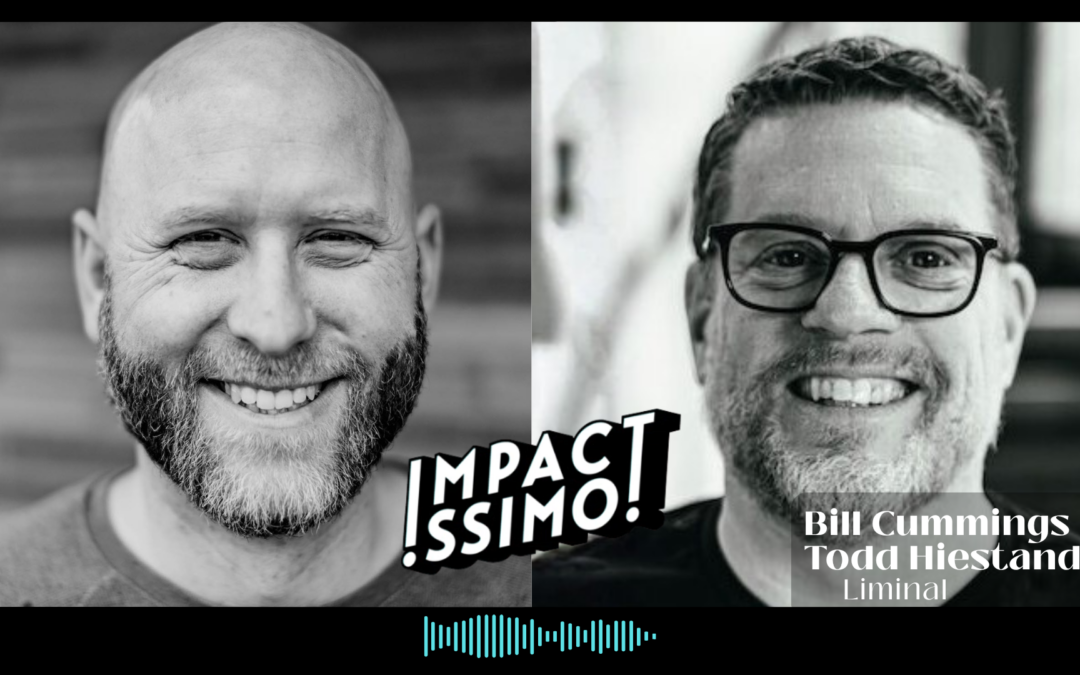
iMPACTiSSiMO! Podcast Episode 58: Hali Lee Author of ‘The Big We’
What if the way out of loneliness, polarization, and civic burnout isn’t top-down philanthropy—but people choosing to act together?
In this episode, I talk with Hali Lee, author of The Big We, about why collective giving, mutual aid, and small actions done in community may be our most powerful tools right now.
Hali makes the case that when we rely on billionaires to “save us,” the rest of us become passive—and that real change happens when ordinary people link arms and do something together.
The allies she’s looking for right now:
- People willing to build or join giving circles and collective action locally
- Connectors who will talk about these ideas and share them publicly
- Community builders ready to bridge divides and bring people together across difference
This conversation is a reminder that democracy, belonging, and impact aren’t abstract ideas. They’re practices—and they start close to home.
Some additional links:
- Philanthropy Together which has a ton of free resources about giving circles (how to start one, how to host one, what to talk about at a first meeting, etc)
- Giving Circle database
- Research on growth of collective giving HERE
Podcast Transcript
Jacob: [00:00:00] We’ve seen an erosion over generations of gathering places and civic spaces and so-called secular church, at the same time, unfortunately, we’re facing a loneliness epidemic and kind of a crisis of feeling powerless and overwhelmed in the face of political turmoil and, and economic forces and author Hali Lee argues for return to some more traditional forms of philanthropy and that also might help us reconnect with our communities and with each other. And she just launched her new book, The Big We, and we’d love to jump in and learn more about that and kind of the big ideas that she’s advocating.
So, Hali, welcome.
Hali Lee: Thanks for having me, Jacob. It’s really nice to be here with you and your community.
Jacob: So quickly, for someone who hasn’t heard about the book, I mean, give us a quick rundown of what it’s even about.
Hali Lee: Yeah, sure. How much [00:01:00] time you got? I can talk about this a long time. So I wrote, this is my first book, and it’s called The Big We, and it’s a book that’s been 20 years in the making, to be perfectly honest. I’ve been building collective giving and giving circles around the country for a long time.
My Giving Circle, the Asian Women Giving Circle, turns 20 this year. And it, which is unbelievable to me. I just can’t even believe it. And in some ways, the stories of the people that I’ve been getting to meet over the last 20 years are so amazing. They’re just totally ordinary people who are doing extraordinary things. So in some ways, these stories just needed to be told, and I get to tell them. So it’s an incredible honor and privilege to get to have witnessed and learned about and recorded, and now get to share the stories of these incredible change makers working in communities all across the country.
The context is another reason why I felt like I had to write this book, and you mentioned a couple important pieces of context, and one is this epidemic of [00:02:00] loneliness in America that is literally killing us. Too soon Americans are dying deaths of loneliness and despair, which is, it breaks my heart it’s tragic. There’s an epidemic of loneliness in this country, which we can talk more about if you want. And all across the world, actually, lots of cities are struggling with this. Mayors are struggling with this in their towns. And then to me, the antidote for loneliness is belonging and building a collective, giving practice. Doing good in groups accomplishes lots of things that are good for our societies and civic engagement, and us as humans, and our hearts and our souls and our bodies. But it also is one way that we can tackle this loneliness crisis. So that’s why it’s one of the themes that runs through my book.
And then the other piece of context, which I know we’ll get into, which is in our sector, the social impact, social change, philanthropy sector in America, sectors rather in America. The prevailing form or frame over the last 20 generations, say 20 years, has been really [00:03:00] focused on billionaires who are directing philanthropy as per their wishes. And I think they’ve done some good, they’ve also done some bad, and I try to make the case in my book that those of us who are not billionaires, all of us non-billionaires out there, have been also practicing philanthropy in the ways in very powerful ways, and honestly in ways that are more democratic.
So I’m trying to make the argument in my book that let’s remember those and reinvigorate them and do more of that.
Jacob: Yeah. Well, it almost feels like, yeah, the term philanthropy is almost synonymous with rich people after they’ve, you know, extracted their wealth from society, then give some of it back to appease their conscience. And it is one like, cynical way to look at it, but you know, like democratizing philanthropy.
I mean, tell me more about that and what, what’s wrong with billionaires running philanthropy? The argument of if people push back, obviously, they’ve done a lot of good, what’s the challenge?
Hali Lee: Yeah. And it’s their money. They can do what they want with it. That’s [00:04:00] another argument. If we were met, if we look at the historical roots of philanthropy as it’s been practiced in the United States as a formal sector, philanthropy as a formal sector, we can look to the first Gilded Age in America. And that’s when the fortunes of Carnegie, Rockefeller, Ford, and others were made in the automobile industry. And, the big foundations that still carry their names are obviously still around today, still doing work in the world. And a lot of it is good work. Carnegie founded a bunch of libraries, public libraries across the country, and a lot of universities and education, et cetera. We’re in a second Gilded Age in this country with big fortunes made in tech. The reason or tech and finance, banking, name the industry. It’s similarly, we are similarly bedeviled by a giant disparity in wealth, with the very tiniest number of very wealthy people owning a disproportionate amount of our country’s wealth.
A couple of books came out about five years ago that are really good, and everyone should read them, you know, about them: Anand Giridharadas [00:05:00] Winners Take All, and Rob Rice Just Giving. If I had to distill their arguments in one sentence, it would be this, and this is their critique of billionaire philanthropy. Their critique boils down to this argument, which is that very wealthy people in this country have very little incentive to change the systems that made them so rich to begin with. And that makes perfect sense. And I agree with that argument. To that argument. I will add mine, my piece in my book, which is that, to rely on billionaires, to save us in any sector, whether it’s government, federal, we’re seeing it now play out on the federal government stage. Also, in philanthropy, to rely on billionaires to save us in any sector inspires a sort of passivity in the rest of us. And our system does not work when we are passive. Our system only works when it’s citizens. That would be you, Jacob, [00:06:00] and me, Hali, and all my, all of our friends, and all the people who are listening to this conversation. Our system works when we, the citizens, the people who live here, care enough to look up. Learn something, get engaged, and I make the argument, link arms with our neighbors, friends, colleagues, coworkers, book group mates, adult soccer teammates, whoever it is, link arms, and then go do action together. Go do something together. And the actions that I describe in my book do not need to be like UN-level actions, like they can be.
I shared this example. I don’t know if it made it into my book, but I shared it at, with a group the other night. A group of my friends and I went to a restaurant in my neighborhood in Brooklyn that was recently opened by a Palestinian American woman who’s starting a business as a restaurant and also trying to feed her family, and raise some money, and do her work. And also, you know, she has a home country, people in her home country who are suffering. [00:07:00] And so we wanted to go support her as a woman, and as an immigrant woman, and as a business owner woman, and we just wanted to go support her restaurant. A few weeks later, I needed to throw a party at my house for my daughter’s partner, who was graduating. And we, I needed to order some catering ’cause I couldn’t cook. I just couldn’t face cooking for that many people that particular day. So I ordered food from her again. So there’s an example of an action that a group of friends can take in support, in solidarity with someone in our community who we just wanted to support as a business person.
Of course, the actions that one can take with friends and neighbors and colleagues and book group mates can be of all types. We could go city council meeting and learn about an issue together. We could read a book about something that we cared about and decide to volunteer at a place together. We could raise money for some place that we wanted to support in our neighborhood. We could clean trash together. We could do a volunteer day together. We could go march some and protest somewhere. We could do lots of actions together. But I try to make the argument in my [00:08:00] book that all of these little actions that I described, from learning and doing actions together. These are actually the elements of being a citizen. And these are the elements of civic engagement. And these actions and elements are going to be stickier for you and be more fun for you and me if we do them with friends, sisters, colleagues, coworkers, neighbors.
And so that’s really what I’m urging people to do in my book. And you know, they also describe mutual aid groups, and giving circles, and learning groups where we can learn about issues and causes together. And that’s what’s gonna make, that’s what’s gonna help us get out of this sort of national doldrums that we’re in. Like the, this miasma of overwhelm, and anxiety, and depression, and what can I do as one human in the face of what feels like an ongoing sort of assault. Especially if you’re an immigrant or a minority, a religious minority, or a woman, or if you’re gay, you know, so many of our people, of our [00:09:00] brothers and sisters are just, are under assault, and it’s easy to feel overwhelmed, and in fact, I think we’re supposed to feel overwhelmed and paralyzed.
Jacob: Yeah, that seems engineered and intentional, right? That feeling of overwhelm. And so, you talk about these giving circles and other forms, like how can they actually make a difference, or like, what are the things that you’ve seen that they can actually do? So is it, like, give us some success stories, and maybe also like contrast that with, what, where does, you know, you used the term Big Phil, right? Like, tell us about that as well. Like, compare and contrast those two of like, okay, grassroots giving versus like this Big Phil scenario. I realize that’s probably 10 questions in one, but where do you want to take that?
Hali Lee: Yeah, I’ll start by telling, sharing who Big Phil is, and then I’ll share a story that exemplifies the first part of your question. I think.
The first third of my book, The Big We, is a critique of big [00:10:00] billionaire rich guy knows best philanthropy, and that’s been the prevailing form for the last 20 years. If you are a nonprofit person listening to this conversation, an executive director or development director, or someone in charge of strategy, and you have ever felt the urge to throw your laptop against a wall, because you’re struggling to fill out some sort of logic model or conform to a new strategic plan, or describe the KPIs that prove the result of the thing that you’re building. You are laboring under the conditions that Big Phil has created in order for Big Phil to justify the spending of the dollars that Big Phil has already set aside to do social good. And Big Phil is often wealthy, and often used to controlling and building the businesses that made them so wealthy to begin with. It’s often a he, it’s often a man. It’s often a white guy. Sometimes it’s a dead white guy who is controlling their philanthropic wishes from the grave. And Big Phil’s done a lot of good in the world, like [00:11:00] polio and disease eradication. But I think it’s clear that Big Phil probably hasn’t paid his fair share in taxes, and Big Phil thinks he knows best. And in some cases, and often cases, he doesn’t. So, part one closes with retire in peace, Big Phil. The rest of us, non-billionaire people, have been practicing community care, social good, fairness, opportunity, and justice in our neighborhoods and towns always. And here is the rest of my book is an exam, are stories of regular non-billionaire people across the country who are doing just that.
And I will share one story from my giving circle that I think shows you the power of what a group of non-billionaire people can do when we come together to love and do good together. It was, I think it was 2009, my giving circle was, we’d been around for maybe five years at that point, and a group of activists applied for a grant to the Asian Women Giving Circle to integrate [00:12:00] the official Lunar New Year Parade in Chinatown to include gay, queer, and trans people to march out loud and ouch in that parade. And to that point, they hadn’t been allowed to march. And so they applied for permission to march in the Lunar New Year Parade and got denied. They applied for a grant, of course, we said, we will give you this money, and we’re gonna march with you. We’re gonna crash the party with you, and it’ll be celebratory and beautiful, and we think fun. So the night before the day of the parade, they got permission, official permission to march. And these activists, these kids, I call them kids, they were probably in their twenties, they were bummed because they were looking forward to crash the party. But of course, they were excited to also get official permission to march, and we marched with them. It was a gorgeous, I dunno if you’ve been to New York, but it was a perfect, gorgeous, clear blue, cold February morning. That Lunar New Year happened to fall in February that year. So that morning, we marched. It was totally fun. We had banners and rainbow colored dragon [00:13:00] puppets, and it was gorgeous.
My son, my youngest son, and my husband, and I marched, went along with the Giving Circle on that day, that night, we were making dinner with our kids. And this group of activists was covered on our local NPR station, they were in Timeout New York, I believe they were covered in the New York Times. This group of activists had made history by integrating the official parade to include gay and queer people, and they beat the Irish in this regard. And Jacob, the size, we were their only funder, you know, we were their only funder who wasn’t like an actual blood relative. The grant that they asked for was $4,000. Our $4,000 grant paid for, I’m pretty sure, beer, and Oreos, and art supplies. So they could do this arts and activism spectacle on that day. And I love this story because it’s an example of what small dollars can do to make big change. These kids integrated their parade before the Irish did. They made history for all of us in New York City, [00:14:00] especially gay communities in New York City. And we, as a group of all-volunteer kind of scrappy donors and philanthropists, got to stand alongside them to make that history.
I share that story in my book because sometimes we don’t do things because we think, we’re just a drop in the bucket, what can one person or one giving circle do? And, we can do incredible things, from helping families to changing history and everything in the middle. And I hope that my book just shares the stories of regular people doing extraordinary things to make their communities more fair, more free, more opportunity, full and joyful for more.
Jacob: Yeah, so, and contrast that with maybe places where Big Phil goes awry.
Hali Lee: Well, there’s so many stories of Big Phil going awry, and I share some of them in part one of my book, and the classic ones, and people are doing better. But the classic ones are Big Phil investing their philanthropy dollars, which [00:15:00] are usually 5% of their capital, ’cause there’s that rule that if you have a foundation, you have to spend 5% out the door for doing the good, the nonprofit good that it was meant to do. But that leaves 95% of Big Phil’s capital being invested in whatever ways Big Phil wants to invest in order to make more money. So the classic example is Big Phil, this is a nameless Big Phil who is spending philanthropic dollars to combat climate change, say. But their capital and investment dollars, their private philanthropy, their private capital dollars are being invested in oil and gas that are exactly at counter purpose to what their philanthropy is doing.
So there’s just a gazillion stories around about that. And people are learning and changing and trying to get their investment dollars to have some values alignment with their philanthropic capital. But then. I’ve seen with the people I work with, they end up butting heads with your wealth advisor or your banker, or your stockbroker, because their [00:16:00] return, they’re only thinking about return in one way. But as a human, we can think about return on investment in a much more nuanced and bigger picture way. And it’s a, it’s an ongoing work in progress to get our dollars aligned. I mean, you just talked about the guests that you had on recently, about every dollar you spend is an expression of your values, and who else said that is Pope Francis? Speaking to the Jesuits about budgets being moral documents, and they really are. Like, how you decide to spend your budget is an expression of your values in the world. And none of us can be a hundred percent perfect. None of us can align every single dollar. But I can ask people to buy my book at bookshop.org rather than going to Amazon, while I myself, I help care for my elderly parents, and when I’m there, I use Amazon in ways that I don’t when I’m in New York City in my regular life, just because I can’t be perfect, right? But we can try to do [00:17:00] good enough, make some progress too. I can order my books through bookshop rather than Amazon. So in a similar kind of way, I think that Big Phil could try to align more of their value, their dollars, align their values in that way.
I tell the story also of, and it’s been covered a lot, and it’s one reason I shared it because it’s nothing new. A group of billionaires and Cory Booker and Mark Zuckerberg, when he was just getting started as a philanthropist, he was still in his twenties, tried to swoop in, and Chris Christie, who was the governor of New Jersey at the time, swooped in to save the public schools of Newark. And it was a failure because they didn’t involve, include, consult the people, the parents, and children, and educators in Newark from the very beginning. So it was like a bunch of wealthy consultants swooping in to change a thing that they weren’t living. And you can predict the results, and that’s kind of what happened.
So that’s another common way that Big Phil can get it wrong, is by thinking they know best and that they can hire and bring in the experts [00:18:00] that know best. Whereas in fact, often the people who are living the thing in the town where the thing is happening actually know best and need to be consulted included in part of the design of what’s gonna happen in their communities from the very beginning.
Jacob: Yeah, I think that the, where the, those closest to the problems are the ones closest to the solutions.
Hali Lee: And the Giving Circle story that I just shared, Q Wave was the group of activists that wanted to integrate the launch in the Lunar New Year parade. They didn’t, there’s no, as much as I love the New York Women’s Foundation, and I was on the board, they funded me, I put them in my will, they fund all they fund everything in New York City that has to do with women and girls and gender, there’s no way they would’ve known about Q Wave. ’cause Q Wave was just way too small, like they’re so grassroots. Their budget is under, I don’t know, it was like, it was not, they had no budget at that time, and the only reason we knew about it is because someone knew someone who knew us. Like it was through a connection of an aunt or a cousin or something, so that’s how they came to us [00:19:00] to ask for this $4,000 grant. There’s no way the Ford Foundation would’ve known about Q Wave. Now that Q Wave has gotten some funding from us and others, they have a much better chance of getting funding from the New York Women’s Foundation or the Men’s Foundation, or someplace like the Ford Foundation. And nothing makes us prouder than have, than to have been that first money in, that’s not a blood relative. We love that. We do happy dances when that happens. They’ve gone on to do bigger, wonderful, bigger and smaller and important things, and we’ve gone on to fund them for lots of things.
And the reason Jacob, we have funded in this arena from the beginning is because, we all know, my giving circle, we’re Chinese, Taiwanese, in terms of our cultural and ethnic backgrounds. We’re Christian and Muslim and Indonesian, Singaporean, Taiwanese, Korean, Japanese. Like we come from multiple Asian American backgrounds and we come first generation immigrants to sixth-generation in America, right? So we’re pretty diverse along these kind of Asian American [00:20:00] parameters, and the reason we have funded in this arena, which is around queerness and gayness and trans issues, is because our families, we all know that it’s really, it can be very hard to be gay in all of our families. It can be almost impossible to be trans in many of our families. We have elders for whom it’s a very difficult conversation and the reason we know that is because, we live it. It’s my family and your family and her family and all of our families. So we know it. So we have funded in this arena from the very beginning because it’s intimately something we get. And so there’s that kind of proximity, not only the proximity to people in the community doing the work, but also the proximity of understanding how latent and hard and complex these issues can be for our families.’Cause it’s our families too.
Jacob: Yeah. Yeah. I want to touch on two things, and I mean, I feel like some of the people that are listeners who might be tuning in might find themselves in a part of the organization of what you [00:21:00] might label Big Phil, right? They’re of that a dead white guy is directing, how their billions are being given away. And that could come off as maybe, oh, you’re working for the evil empire or something. And no, they’re still doing good. But what advice would you have for them to maybe consider? What invitations would you have for them that maybe can help align or shift, you know, maybe their practices? Like what have you seen, what are some best practices there, or advice you might have for somebody that works in philanthropy right now?
Hali Lee: Yeah, there’s one of my favorite organizing strategies, in a way, is an inside, outside, inside, outside thinking. And it’s these jobs often are really good jobs that pay for really good health insurance and IVF and parental leave for all kinds of parents. Like these are important jobs, and I am not one at all, I’m not at all downplaying the importance of keeping [00:22:00] a really good job. And sometimes, some of the compromises we have to make in order to keep and get and keep a really good job for our families and ourselves. So I’m not downplaying that at all. And one of the things that I’ve, and I have a lot of friends who work at Big Phil, lots of places that are, that might be considered Big Phil, and there’s a lot of good work being done. So obviously lean in to the good work that’s being done and see what you can do in terms of internal organizing. Is there an eRG group that you can join that’s like for queer folks, or people of color, or people who care about equity and justice within the organization that you work in? Is there a matching? A lot of the, like Ford has a three-to-one, I think, matching program. So if you give to the Asian Women Giving Circle has been fortunate enough to get this match. So if someone gives $500 that turns into $2,000 because of this triple match, maximize your ability to do matching dollars, and for that non-profit that little organization [00:23:00] that’s getting $2,000 from the Ford Foundation through an employee match, that’s meaningful.
That’s something that a small, like my giving circle, can brag about that ’cause we don’t get grants from big organizations like that. We can use it to help us fundraise with other people. Another sort of way in that I’ve heard is that sometimes it’s easier for people who work within philanthropy to get to buy a table at a gala. It’s a way to get money to the nonprofit that doesn’t involve like going through the whole grant allocations process. But a lot of Big Phil philanthropic organizations have money for things like sponsorships and galas, and it’s a way to get $5, $10, even $25, even $50,000 to a nonprofit by buying a table or underwriting or buying a page in the book or underwriting a blah, blah, blah, blah at a commemorative thing or a gala or whatever. So that’s another way to get support out the door.
And then some, many Big Phil organizations have like an [00:24:00] anniversary date of hire. So if you’ve worked, Jacob, at this place for five years, you get to give $5,000 that year. Once you have been there 10 years, you get to give $10,000, and it’s pretty open. It doesn’t have to, I think there’s a typical C3 kind of terrorist organization screens, but besides those scrapes you can give to most nonprofits in the United States, mostly, for these employee benefit kind of thing. So maximize that, do not let that opportunity go out the door.
And then my last point, ’cause I have a lot of ideas here. The last, there’s a very powerful thing that Big Phil and people who work in big philanthropy can do that doesn’t cost a lot of money, and that’s to convene people. And I’ve been convened. And if the Gates Foundation convenes people around Asian American, blah, blah, blah, blah, and they invite me to come, I will go. And the reason it’s important to do that is that it’s a chance for me to be in a room with other people who care about [00:25:00] Asian Americans, and equity, and joy and fairness in Asian American communities. And it takes us out of our day-to-day and gives us an opportunity to spend hours together thinking about the broader, larger ecosystem. The 10,000 feet up point of view, which most of us who are running projects and running organizations don’t have time to do, but we need to spend more time doing that and building those bridges across silos and across our bodies, our specific bodies of work. And foundations who have money and budget and sort of the influential power to convene us, that’s a huge thing that they can do and lean into that doesn’t have to come out of grant-making budgets. That doesn’t have to come out of, so it’s something that program officers can do that doesn’t have to come out of their regular kind of jobs in a way.So that’s something I often talk with folks about doing too.
Jacob: Yeah. Totally. So if I’m not a part of a giving circle right now, that feels maybe daunting to spin one up or like, maybe there’s, you know, [00:26:00] what does that actually take or walk us through, like, if someone feels some nudge towards that or like, is curious like where do they even start?
Hali Lee: Great question, and not everyone has to start one for sure and I’ll share the link afterwards, but there’s a group called Philanthropy Together, and I helped build it. It’s the first-ever infrastructure hub organization that supports giving circles and collective giving around the globe. And this is a field and movement that is totally booming around the world, which is exciting. And there’s a, they have a directory, so you can literally put in your
code and find, you’ll find dozens of giving circles in your zip code. And then you can call them and email them, or go to their website and see if there’s a fit.
If you want to start a giving circle, my first piece of advice is: it’s not rocket science; I would say just do it. It doesn’t have to live forever. My advice to think about starting one would be to start with a group that you already have. So maybe you’re part of a [00:27:00] book group or literally people start them with them, their teammates on an adult soccer league, or maybe you’re part of a block association or a parenting group, and that’s like, If there’s a group already meeting that’s already one hurdle that you’ve already solved, and then to make a giving circle out of that, you’re literally adding, like, let’s talk about things that are important to us and if we’re being very brave, we could add some money to the conversation.
And there’s a whole chapter in my book about like how to talk about money, ’cause many of us were told when we were kids not to talk about sex, money, and politics. But those are the most important things that we gotta talk about with people who are, we’re in community with. And then remember that nothing’s perfect, you’re gonna screw up, so build in learning and humility as group values from the start. Don’t try to be perfect ’cause nothing’s perfect. Don’t let perfection be the enemy of the good in terms of numbers; kitchen tables are a metaphor that runs through my book. And it’s, and the reason is that kitchen tables have been the locus of so much powerful organizing in America, [00:28:00] always, especially by and for women, queer folks, people of color, and immigrants. So I like to think about, if you’re thinking about starting one, how many people fit around your kitchen table or in your living room? Or do you have a friend with a kitchen table or a living room? If you don’t, think about that number of people as a good number to start, ’cause you don’t want it to be too big, but you don’t want it be too small. And then to the metaphor of the kitchen table, an important caveat, an addition, which is to add a seat or two, or add a leaf for people, invite some people who are just outside your regulars. So for me, like the people who I would call just to come over for dinner are gonna tend to be like me. They’re gonna be women or parents, say with young adult children or kids who were college age in Brooklyn, I lived in Brooklyn or whatever, who work. So if I wanted to invite some people who were just outside that group, I might invite some friends from college, say, [00:29:00] who don’t have kids or who do have kids, but they’re a different age, or who live in a different neighborhood, or who work in different sectors. Like just a cut few people to keep it a little bit more, a little bit more diverse.
And again, I like going back to that idea, you don’t have to be like UN-level diverse, just think about like just outside your regulars, so that we don’t reify and don’t build echo, echo chambers because we already are doing enough of that in America right now.
Jacob: Yeah. Yeah, very true. And I love that idea of just that slight expansion and like including more people in the circle. Let’s talk about what are the allies you need most right now?
Hali Lee: We all need community. I, we need allies, we need friends. I just think we need to try to build community wherever we are. I have a theory about it. Like my block in Brooklyn is obsessed with rats and trees, so we get together to [00:30:00] talk about rats and trees, because during COVID, the rat population in New York really soared. And like a rat ran over my foot the other day when I was walking my dog. It’s really gross. And we have these big, beautiful stately trees, and every once in a while a limb falls, so we gotta deal with it, we people watch out for limbs that look a little bit tenuous.
My Stitch and Bitch Group, which is a group of mom friends from preschool, they get very animated about reproductive rights, and other women’s and girls’ issues, so they animate. We get together to stitch and bitch, and then we also get together to do stuff around repro and women and girls and gender. I’m part of a food co-op that cares a lot about local, good quality, well-resourced, ethically raised, and grown food. All are different communities, that, and there, and multiple, many more that we can all, if we sat down and thought about it, and we’re all parts of these different communities. And my kind of theory about this is that, there, those are the ones I’m part of, and there’s Venn diagrams [00:31:00] between my neighborhood group and my Stitch and Bitch group and my food co-op, and my mom and dad circle, and my college roommate circle, my work, my beloved work teammates. All of these form kind of a Venn diagram, and if we can think about that, the Venn diagram starts to get bigger, actually, as the groups that I’m in start to form and come together in my head and through my hours of participation and in my life. And if we can, if you and I could talk about your groups and your Venn diagrams and my groups and my Venn diagrams, then if we need to get together around something that’s happening in Utah and Brooklyn, I don’t know what that might be, or maybe there’s some issue that your groups and my groups care about together, then we have a basis upon which to start having some relationship and start building some trust, so that we can work on that thing together.
And it’s that kind of muscle that I think we, all of us in this country need to lean into, rather than what we see happening now, which is you over [00:32:00] there and me over here and there as many divides and as much barbed wire and big, tall fences and hedgerows that can be built to separate you and me that’s kind of the vibe of what’s happening right now nationally. And it’s by design, Jacob, because we are stronger if we can find the Venn diagram connections, than we are if I have to only talk to you from a mile of a DMV, A demilitarized zone that separates us,
It’s on purpose that we’re being kept apart like that because together we are formidable. So it’s on us as citizens who care about rats and trees, women and girls, education, clean food, air, it’s on us who care about these things that all of us actually care about, really. To find the Venn diagram overlaps and to find the connections, because that is the [00:33:00] strategy for how we will fight the forces that are trying so hard right now to divide us.
Jacob: Yeah. Amen. Yeah. Be a bridge builder. Be a connector, not a divider.
Hali Lee: And talk, Right? Like we have to find the connections. And Jacob, I know we just met, but I think if we talked more, I would find something. I’m 99% sure I can find something in your familial background. Your grandma, your grandpa, your aunt and uncle, your great-grandma, that is connect, that is similar to something in my background too, across Utah and Kansas City and Brooklyn and Korea. I don’t know where your family comes from, but across the vastness of our differences, you and I will be able to find some important things that we share. And it’s having those conversations and making those connections with people who seem really different from us that is our way out of this.
Jacob: Yeah, no, I, there’s singing a [00:34:00] song that really resonates for me. I mean, with my work, I get to travel the world and meet people from all over, and they almost sound like two different realities. But one, there’s such a rich diversity of thought, and expression, and way people live, that is so fun to see different places and experience.
And at the same time, what unites us is far stronger than what separates us. And the human experience is far more unified, and we’re so much more similar than we give ourselves credit, or that we’re led to believe. And I think I totally wholeheartedly agree, like you put two human beings in a room, and there is just so much more that unites us than divides us.
Hali Lee: I think you’re really right. And I think if we really thought about it, we would agree. Like I made a point of including in my book, two White guys who come from deeply Republican families in the US context, Democrats and Republicans, and my dad has voted Republican most of the time in the US, except not for the current guy. Because in [00:35:00] his point of view, coming from Korea at a time that he, at the time that he did, the Republicans were better at fighting communists, like that’s his frame historically. But I made a point of including these two men in my book, because if I lived in their towns, I would want them to have my key; they’re just like really decent guys with a lot of integrity, and I trust them. We might vote for different people on some things, but they’re like really decent people. And what, just to build on what you said, I think most of us, and everyone in my book, and you and me, and most of the people I know, and all the different cities that I go to and travel to. We wanna be good parents, we wanna be good neighbors, we wanna be, we’re, we think of ourselves as hard workers and people with integrity, who are honest and want our kids to have more opportunity than we had. We want our kids to do better than us. Like we want the opportunity. We want our kids to have as much opportunity as they’re able through hard work, and education, and our support.
And I want the same for your kids as I want for my kids. And that’s the [00:36:00] thing that, the trick, like that’s the thing that we have to get over is to think expansively about who are our kids, who are our children? I want the same for her kids over there as I want for mine and yours, as you want for mine.
Jacob: Yeah,
Hali Lee: And that’s what I think we actually share. If we could just tune out some of the noise that we’re being told to believe and listen to.
Jacob: Yeah. So to help Hali and to help the, your book or whatever cause you’re looking for, what would be like three ideal connections to help you succeed right now?
Hali Lee: You are so nice to ask me that, and I don’t really have a great answer other than, Help me, like it helps me to buy my book; selling books is hard. Go to bookshop.org, or I don’t know wherever you get your books, if you wanna listen to it. I narrate it, so that’s fun. If you’ve enjoyed this conversation. So buy my book, that’s a big help.
Talk about what’s important to you, you know, try to build those bridges with people who are just a little bit different than you. [00:37:00] And then write about it post on LinkedIn, tag me somewhere, because these are the ideas that I’m trying to get out there in the world. And I think the more of us who are talking about it and building those conversations and those bridges across some difference, the more of us for whom that will resonate. And that’s really, I really care about the state of our country right now, I really care about the divides that divide us. I just, I don’t think it’s a good world we are leaving for our kids, and I actually really care deeply about that.
So that’s what I’m trying to get people to talk about with my book. So it helps me a lot, actually, if you talk about the ideas that are in my book. And post on Facebook or LinkedIn or wherever you or your friends don’t post if you don’t want to, but keep that conversation going that helps me, and Jacob, I think, too. And then just reach out, build, don’t be afraid, build the thing that you wanna build, join the Giving Circle. Just do it. I feel like in that Nike ad, just do it. You can, if I can do it, you can do it too. And [00:38:00] then share your story so that I know about it. I’d love to hear it.
Jacob: Love it. Before I let you go, What’s the last, What else do you wanna say before we wrap this up?
Hali Lee: What else do I wanna say? To the people in our sector, because I think there are listeners on this, to this podcast who are in the social impact sector. I think one of the things that we can all do right now is make obvious the connection between what we do and civic engagement, and what it means to be a citizen.
What does it mean as an individual, and as an organization, to be a citizen in our communities as we define it? And if I’ve written my book well, I try to make the case that coming together to do good in groups is a really good way to exercise our civic engagement muscles, and if ever there was a time when we need to do that in this country, it is right now. I will leave it at that.
Jacob: [00:39:00] Yeah. Well, Hali, thank you for the message that you’re championing and the good that you’ve done. And I applaud what you’re about and you’ve given me a lot of great ideas to run with and try to continue that conversation. So, hopefully you leave though knowing there’s people who have your back or that are cheering you on and thank you and keep up the good work.
Hali Lee: Thanks for having me on, Jacob. It’s been a real pleasure.
Jacob: Thank you.
Learn more about ISSIMO Story Agency Here