
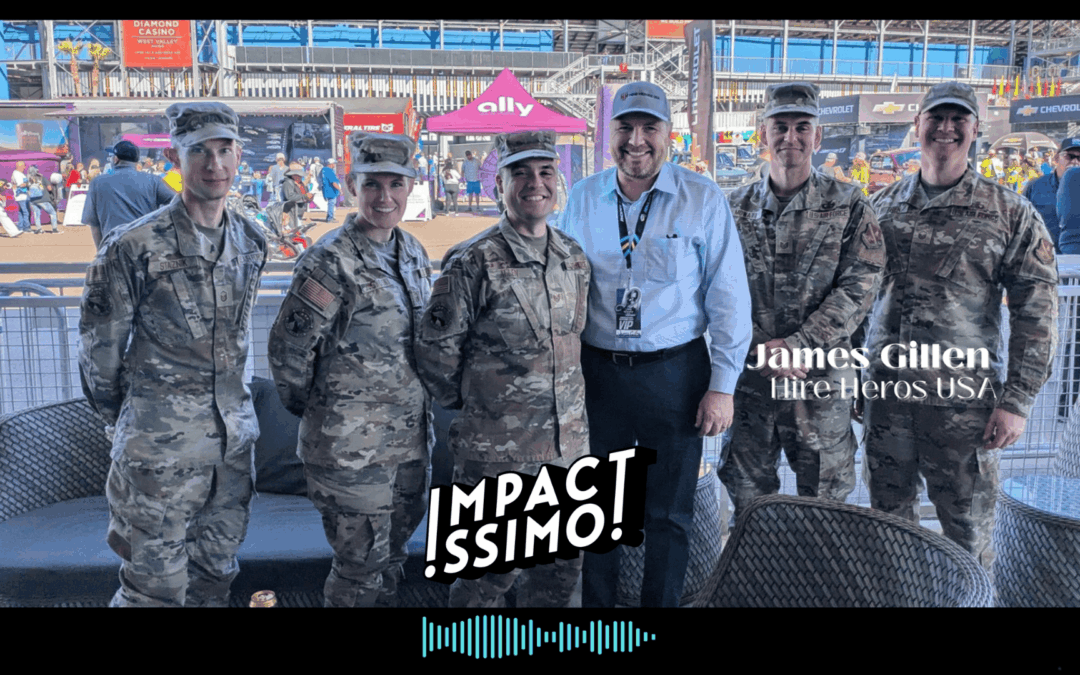
iMPACTiSSiMO! Podcast Episode 56: James Gillen with Hire Heroes USA
Every year, more than 200,000 men and women leave military service—and many of them step into a civilian world that doesn’t quite know what to do with the skills they carry.
How do you convert years of discipline, adaptability, and technical expertise into a résumé that makes sense outside the military?
James Gillen with HIre Heroes USA explains how his organization helps over 14,000 veterans and military spouses each year to find meaningful jobs in the workforce – with over 110,000 confirmed hires and $970 million dollars of economic impact on communities.
They are looking for:
- Corporate partners who are looking for a capable talent pipeline to consider a veteran. Check out www.hireheroesusa.org to connect with their partnership team.
- Professionals who are willing to hold mock interviews in their areas of expertise.
- Those looking for incredible talent.
Podcast Transcript
Jacob: [00:00:00] Welcome to the Impact-ISSIMO podcast. We highlight the stories of impact innovators and connect them with allies they need to amplify the good they can do in the world. I’m your host, Jacob Hoehne. I don’t know if you’re a nerd like me, but I remember growing up watching White Christmas, and there’s this lovely song by Bing Crosby of “What do you do with a General When He Stops Being a General.”
Yeah, and there’s that song, though, that I think illustrates an actual real issue of those that are serving in the armed forces. How do they transition out into gainful employment? And I originally met some of the Hire Heroes team during the Halo Awards gala during the Engage for Good Conference, and was really impressed with the work that they do to help us military members, veterans, and their spouses to find meaningful work.
And today we have Jim Gillen with Hire Heroes, USA, and welcome.
James: Thank you. Glad to be here.
Jacob: How do you make the world a better place?
James: At Hire Heroes USA, we’re a national [00:01:00] nonprofit veterans organization, and we work to empower transitioning military members, veterans, as well as military spouses to succeed in the civilian workforce.
You know, from individual career guidance and mentoring to professional resume writing, interview, training, and even mentorship. We work with the unique needs of each one of our veterans and military spouses so that we can help them transition. Into the civilian workforce.
Jacob: For those who might not be aware, what are the unique challenges that those leaving military service are finding that are maybe different than just the average job seeker?
James: I’ll just take some examples from my own personal life as well. I think every veteran’s path is very unique to them. In my case, I served in the military, in the Army I was 17 years old. And I was what was called a junior enlisted, so I was an E1 to E4 when I was an E four when I transitioned out.
So the transition for me at a very young age, at 21, was very simple. I just moved straight into college. That’s not the experience of a lot of military veterans. And [00:02:00] my father was a marine helicopter pilot in Vietnam, and he flew the Chinooks, the double propeller helicopters. And when he came home to a small town in East Tennessee, there weren’t a lot of demand for, you know, Chinook helicopter pilots in East Tennessee. So, his military transition was completely different, and he went through multiple career phases in his life to try to find what was right for him because he didn’t know how to translate all the success he had in the military and all the skills he learned into the civilian workforce.
And I think there’s so many military members that experience that same thing. How do you translate leading, you know, men and women in combat or in peacetime into the civilian workforce in a way that employers are gonna understand that?
And military spouses, who we also serve, have a very similar experience. They have many times a job history that’s very fragmented because they’ve gone through multiple transfers with their spouse, and so that may not always translate very well, but they have served our [00:03:00] country in a capacity that I think is very unique and gives us an opportunity to show them a way where they can highlight that for a civilian employer.
Jacob: Paint for me a picture of just what the severity of the problem you’re trying to solve here.
James: Currently right now there’s over 16 million veterans in our country. Every year there’s over 200,000 military members that are transitioning out of the military, and many times they don’t have a plan that’s clearly laid out.
The military has worked hard to put a lot of opportunities in place for them as they’re transitioning out, but one of the most in-demand needs for transitioning service members is career advice and career help. The need is great, and as a matter of fact, that’s one of our challenge most challenging aspects is the capacity to be able to serve them all. Each week, we have over 800 people register for services through us. That’s over 40,000 veterans and military spouses a year, and we just don’t have the capacity to serve them all. And so that’s probably one of the greatest needs. And, as we look at what’s going around the [00:04:00] world, I think that will always be, you know, a need for this country.
Jacob: How does it actually work on a practical level? What are the specific things that you’re doing to help these veterans and spouses of veterans get meaningful jobs?
James: It starts with just getting them to register. And so once they register in our system, and we verify that they are a veteran, we assign them a transition specialist.
They have a very specific caseload. Typically, they take in nine new clients per week, each transition specialist, and then they work one-on-one with that veteran to understand what their needs are. Do they need something as simple as a resume? Do they need career coaching, interview coaching, so that they can work through employer interviews more effectively? We even do mock interview sessions with them, and then we even go to the point where we have a job board where we match our, our clients veteran clients with employer partners that are in the marketplace looking for that talent.
But most importantly, you know, when we go through that career coaching with them, we take a look at their resume.[00:05:00] And, we start highlighting those areas where we can translate those skills into the civilian workforce. So when they, you know, finish their work with us as a client, they’re fully prepared to talk about their military career, but talk about it in a way that connects with the civilian employer, and they see the value in that.
Jacob: On a macro scale, What’s the evidence that this is working? You know? What are things you can point to? And then also just on the individual success stories, can you share some of those?
James: Every year there’s about, you know, 200,000 of the veterans that are transitioning out. Out of that, you know, we have roughly 40,000 that are reaching out to us, and then we’re servicing at about half of those right now, around 25,000 or so per year. This, this past year, we helped over 14,000 veterans and military spouses find specific meaningful jobs in the workforce. And the average salary, starting salary for those individuals is $72,000 a year. So that’s been really successful. It’s not just [00:06:00] for them and their personal life, but it also benefits their family, It benefits the community as a whole as well.
Jacob: If they have a good job just that ripple effect that it provides for the family and the community. So you’re helping veterans and families and communities, you know, and times 14,000 a year. That’s fantastic.
Yeah. And maybe on that second part. What are some of the individual success stories you can share?
James: Oh my goodness, there’s so many. We, you know, we recently held our annual gala in Atlanta that we hold every year, and we were able to highlight a few of the success stories. And in one case, it was a military spouse and her husband died during COVID. She was a nurse, and it was this incredible story of, first, the sacrifice for her, you know, she was serving all these other people that were sick during that time. But, yet she wasn’t able to help her husband, and he passed away, unfortunately.
She had reached out just shortly after that, you know, for some career help. She had taken some time off, and she decided at this point it was time to get back into the workforce. And as a [00:07:00] military spouse, she was able to connect with Hire Heroes, and we worked with her really well. But you know, as she related, there were some days that she just couldn’t get up to strength, to really have a conversation about, you know, what comes next in her future.
But that transition specialist was still there for her. They would, sometimes they would just reach out and just to see how she’s doing, just to touch base, you know, find out if there’s anything they could do for her personally, and just kind of be that friend to her during that time. And then when she was ready, then she was able to reengage and they worked with her all the way through her finding new employment, and she’s doing amazing, amazingly well now.
So, that’s just one of, you know, 14,000, you know, stories that happened just this last year that I think really highlights and not just, you know, what we’re doing for them from a functional standpoint, but that we’re also a support system for them.
Jacob: Yeah. Lovely. What would you say are maybe the biggest misconceptions that potential employers have about hiring veterans?
James: Oh my [00:08:00] gosh. You know, I’m glad you asked, and you know, unfortunately, I think, and this is more so prevalent over the last 20 years or so, is that, and I think a lot of nonprofits have kind of done this in a way, not intentionally, but because there has been such a need to serve veterans that there’s been such a highlight on all the problems that a veteran may or may not have. And so the narrative has been of the broken veteran, and that is, you know, far from, you know, what the reality is. And so I think that’s the biggest challenge. A lot of times, people are gonna think that the veteran is gonna have PTSD or have, you know, other issues that they’re not sure that they want to take on.
And so while everyone, you know, in the world has issues that they’re struggling with, veterans included, veterans are some of the most resilient, the most diverse workforce that you could ever imagine. They’re disciplined, they have leadership skills that are beyond anything that you would see in the civilian workforce.And they make amazing employees. And so, [00:09:00] that’s a battle that I think that veterans face every day. And then when, if you’re a military spouse, a spouse is very similar as well, there’s many times as well, is your spouse gonna be transferred and are we gonna lose you, you know, in the short term? Or if you’re in the reserves, are you gonna be deployed soon?
So there’s so many of those things that come up that veterans face that are really not issues for the employer, and they’re missing the strengths of that veteran.
Jacob: What would you say organizationally is your biggest hurdle right now?
James: Yeah, I think capacity. I think being able to reach more veterans.
As I said, we have, you know over 800 a week that come in and register for services. For an organization our size, we’re able to service about half of those. And then the other half are kind of in that queue and waiting. And so,that’s probably the biggest challenge.
And so that’s why we really increasing our funding efforts and our outreach with our corporate partners, employer partners as well, so that they can see the value in the talented workforce that we can bring to [00:10:00] them so thatt we can, you know, hopefully increase our capacity and serve more veterans.
Jacob: Yeah. So what are the allies you need most right now?
James: Sure. I think, you know, there’s several different allies, you know, kind of categories that we really need the most. And you know, when it comes to corporate partnerships, I think that’s key. When you have, you know, a company that’s willing to get involved on multiple levels and give opportunities to their employees, to volunteer in the specific industry, to mentor our veterans, I think that’s key.
But think about the mock interview process. For instance, if you have somebody in a very specific field. Whether it’s a financial, the financial industry or some other field, and they’re able to actually, you know, conduct mock interviews for some of our candidates that are interested in that industry.That’s a tremendous help. And that’s something that a company can get involved in at any time, and gives their employees an opportunity to get engaged.
Obviously, you know, assisting us with funding our mission is key. Ways that we can, you know, partner with them to be [00:11:00] able to reach more veterans and serve more veterans are incredibly important.
And simply hiring veteran talent, you know, if they’re looking for a talented workforce that is dedicated and has tremendous leadership skills to be able to come to us and let us connect you with some incredible talent, I think that’s one of the biggest areas that’s needed as well.
Jacob: Yeah, love that. And the effort we make on this is as we post it to LinkedIn, we try to connect you with about five different organizations or individuals we feel like, where there’s some potential synergies. And so that’s something we try to do to cross-pollinate, to create those connections. As you tell the Hire Heroes story, try to attract potential donors or partners.
What has worked, what hasn’t? Like if you had to boil down your years of experience with storytelling about this what has worked for you?
James: Sure. You know, I think it’s one telling the strength of the veteran and [00:12:00] the impact that our partners make doesn’t stop with a veteran. When you give a veteran an opportunity to excel in your organization, you’re also, you know, benefiting that family. And then beyond the family, you’re benefiting the community as well. And so when we think about our impact that we’re having, it’s not just on the veteran. And so when, you know. When we serve 14,000 veterans a year and help them find meaningful employment, that translates into over $970 million in financial impact for the community as well.
So, you know, for those organizations that are out there that are thinking that, you know, they’re backing away a little bit from the veteran, you know, focused initiatives, which you know have happened over the last few years, but they’re leaning into the community, and you know, service-type areas.Think about that impact that’s happening in those communities across the countries where the country, where these veterans live. That’s a tremendous financial impact.
Jacob: Have you seen any negative impacts with any current policy changes or federal grants? Different nonprofits [00:13:00] are experiencing different things? Like, how has that affected your organization?
James: Well, so far not a great deal, but I think, you know, the political landscape is always changing, so I think we have to be mindful of that. We have not been overly reliant on federal funding over the years. I think that is beneficial to us. So corporate, you know, funders at one time.You know, the veteran, you know, initiatives were one of their main, you know, funding priorities. They’ve shifted to different areas, you know, whether all, all meaningful, but what’s interesting is that a veteran goes across all those areas. You know, we think about homelessness, when you think about food insecurity, think about, you know, community development.
The veteran really is that line through every one of those initiatives. And I think we have to do a better job telling that story and seeing where those things connect.
Jacob: So before I let you go, What last things do you wanna leave our audience? What else do you wanna say?
James: I think at the end of the day, you know, if, especially our employer partners and our corporate partners that are out [00:14:00] there, if you need tremendous talent that’s dedicated and loyal and has tremendous skills that you don’t find naturally in the workforce, look at a veteran and give them a second look.
And even if you don’t see it on the surface, and maybe they’re not a client of Hire Heroes, and they haven’t been through our program, but there’s some tremendous skills that they have that they just haven’t figured out how to translate those, you know, on a resume. But if you really want to find some incredible talent, reach out to us.
Come to our website, www.hireheroesusa.org, and we can connect you with our employer partnerships team as well as our team that handles our veteran clients and then bring you together.
Jacob: Fantastic. Just want to thank you for the good work that you’re doing and keep up all the efforts, and God bless you in what you do.
James: Thank you so much it’s a,great opportunity to be here, and I really appreciate it..
Jacob: Thank [00:15:00] you.
Learn more about ISSIMO Story Agency Here