
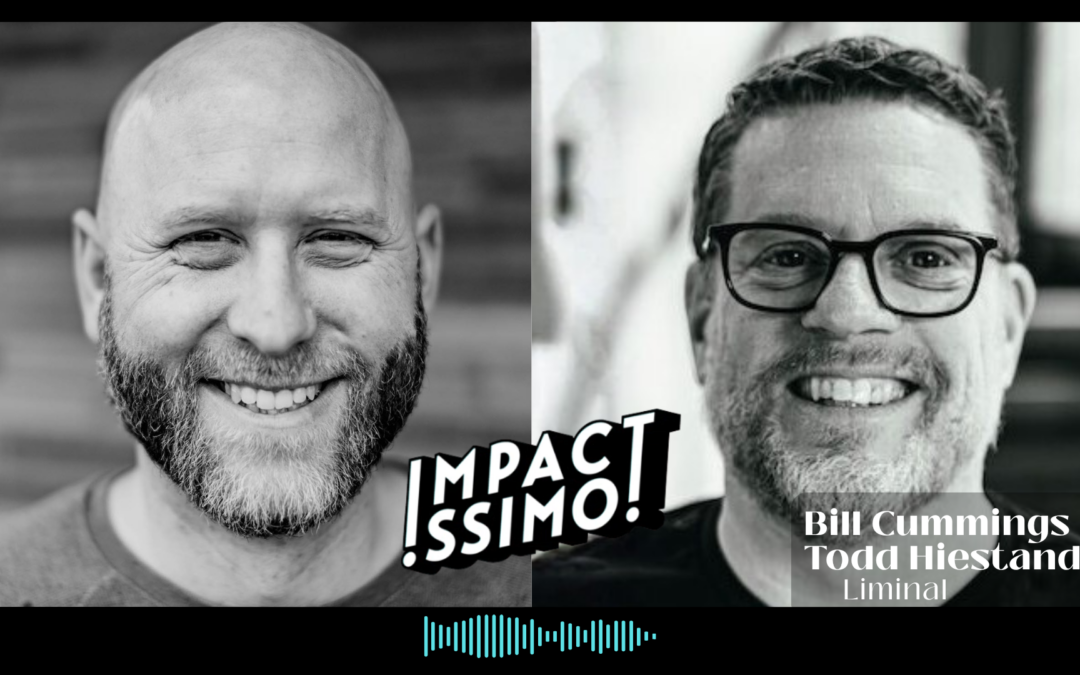
iMPACTiSSiMO! Podcast Episode 57: Todd Hiestand and Bill Cummings with Liminal
You can be doing extraordinary work—and still be invisible to the people who want to help. They won’t give unless they “get” what you are all about.
In this candid conversation, Bill Cummings and Todd Hiestand from Liminal unpack the most common branding and messaging mistakes nonprofits make as they grow: dumping complexity on first-time visitors, telling the same story to every audience, and mistaking humility for invisibility.
They explain why clarity builds trust, how strong branding signals real capacity (not excess), and why investing in your organization isn’t a distraction from impact—it’s how impact scales.
The allies they are looking for right now are:
- Paid media and growth partners who understand the nonprofit landscape and can help organizations scale visibility and fundraising responsibly—without pushing overly commercial or transactional tactics.
- Video and storytelling partners who share a human-centered, dignity-first approach and can translate complex impact into clear, trustworthy narratives that build confidence with donors and funders.
- Operational and infrastructure experts (CRM, fundraising platforms, systems and data) who help nonprofits strengthen internal capacity and prove they are ready to manage larger gifts and long-term growth.
Podcast Transcript
Jacob: [00:00:00] So, trying to make the world a better place is hard enough, but most nonprofits try to do it alone, unfortunately, and they often fall into some of the same mistakes as they try to share their story. So today, we have nonprofit branding experts, Bill and Todd from Liminal, who are going to share how to avoid those common pitfalls and what makes a successful nonprofit brand.
So Bill and Todd, Welcome.
Todd: Awesome. Thanks. Great to be here.
Bill: It’s great to be with you.
Jacob: In a nutshell, like what is Liminal? What do you guys do? What do you stand for?
Bill: The first thing that’s like helpful context, I think is that Todd and I both come from the nonprofit space. We both led, and founded, and served on boards, and been development directors; had the privilege of traveling to different places in the world, working in [00:01:00] some of the world’s biggest problems as nonprofit leaders; and we say we have 50 years of combined nonprofit leadership experience. And Todd likes to joke that I have 45 of those years and he has five, but that’s not true.
Todd: It’s not because I’m not experienced, it’s because Bill is so old. That is the key thing there.
Bill: I am a little bit older, but it is probably more 30 and 20, but that’s what we’ve done. We’ve been, for those of you who are watching or listening, we’ve been in your seat. We’ve been founders, we’ve been executive directors, CEOs, again, chief development officers, and we know what it’s like to be passionate about a cause, working hard to get that message out, and let people know how important it is that their support and engagement and partnership is needed in that work. And I think over the years in that world, we just became really passionate about making sure that [00:02:00] nonprofit organizations were telling their story well. And we know that’s what you do a great job of as well, Jacob. We do that from a little bit of a different angle, but five years ago, we founded Liminal. As an agency that works specifically with nonprofit organizations that serve in under-resourced communities, both here in the United States and around the world. So we do that through strategy, branding, and engagement.
So our focus is on messaging first, making sure that our organization nails down its core messaging, that their story is clear, and we deliver a very comprehensive core messaging stack that captures their story in a way that’s clear, consistent, compelling, across the board, and then we do full-on branding. So redesigns, rebranding, logo design, hex codes, colors, typography, and then implementing that on websites and every [00:03:00] bit of collateral or marketing materials that you can imagine across the board to help people engage with their work. That’s it in a nutshell. Todd, did I miss anything?
Todd: Yeah. No, I was just gonna add that we found that there’s so many nonprofits that are doing incredible work, Jacob. I’m sure you see all the time, right? Like with your clients, like they’re doing incredible work. They’re really creating great change. And like you’ll meet them in person, this happens all the time, like I’ll meet a guy, I’ll meet a leader in person, and I’ll be really impressed with their organization, with their leadership, with their work. And then I go visit their website when I get home, and I’m like, this can’t be the same organization that we were just meeting with, it just doesn’t, there’s, it’s just, it’s not congruent. It’s just, it’s not well defined. It’s not real clear. It’s not very quality, and it just doesn’t match up. It’s a mismatch or a gap between the quality of the organization leader and the marketing and communications, and it’s just, we’ve seen it all the time.
And so a lot of our work is bridging that gap between those two, those two realities. And we’ve seen a lot of [00:04:00] success in helping organizations who have high capacity; Have people realize they have high capacity. It’s usually not that they don’t have high capacity, it’s that they have it, but no one knows they have it because their marketing is not well-defined. It might even be pretty, but it’s not real defined. It’s not real clear. And clarity is one of our biggest things these days, is how can we help you get more clarity, so people can just be like, oh, I get it, that makes sense. I totally understand it. And as we say all the time, they can opt out of that conversation at that point, or they can opt in and be like, I really wanna be part of this because I get it. And so that’s, yeah, that’s the problem we’re trying to solve is helping nonprofits solve their problems with more scale. And not all, you said all these nonprofits are solving the largest problems in the world. We’re trying to help them solve those problems more effectively, efficiently, and at a greater scale.
Jacob: How do you respond to the concern or question of, Hey, every penny I spend on marketing, that could be, that’s fluff, or that’s nice to have, but like that penny I spend with you isn’t going to save the whales or the rainforest or the [00:05:00] starving child. Like, how do you justify an investment in branding when it’s taken away from programming or from the cause?
Bill: Yeah. I think one of the things we do is have a lot of conversations when we meet with prospective clients to get a gauge for where they’re at as it relates to that. Some are completely convinced; they know they don’t need to be talked into it; they need to rebrand. They know it. Others come to us like, Hey, we just need to upgrade our website.
And like Todd said, we’ve spent five minutes on your website, and we’re still not sure what you do, and we’re trying really hard to figure out what you do. Like we wanna know. What happens with those who aren’t trying as hard and don’t have the time to figure it out? So we’ll talk to them about a broader scope of work to make sure that we’re really hitting on the things that we think will help them.
And during that process, we will, we’ll find out that there’s some people that like, yeah. Or we had clients say to us directly, Hey, we wanna make sure our website’s not too nice or not too fancy, ‘cause we don’t want [00:06:00] people to think, we don’t need their money. That’ll give this impression, like, oh, we’ve got all this money, we don’t need their donations. And we’ll basically say we don’t think that’s a real thing, that’s a perception that you have. But a website can only be so fancy; you could add all kinds of bells and whistles, but those things would end up distracting if you added too many different, moving parts and animations and all of that. But we feel like a website should be high quality, like Todd said earlier, because we want to make sure that the quality of design, the quality of messaging, the quality of your story being told, and how that’s laid out and the hierarchy of that, the UX and UI, and all that stuff is engaging. Where people wanna, they wanna learn more. They wanna click the learn more button, they want to click the read about our team, or look at our, check out our blog, and check out our stories, to stay more engaged. That’s a conversation we have.
And then we also have [00:07:00] taken the time to really do some digging on the clients that we’ve served over the years, and across the board clients that we’ve done a full on core messaging rebrand, website redesign, and kind of a full service marketing, like slide decks and just anything and everything, annual reports, case for support, all the things that get put out in front of the public. When we do all of that across the board, those clients over three years have seen a 228% increase in revenue. And we’re not saying we claim, that’s all because of us, clearly it’s because they give great leadership, they’ve got great programs. They’re making a great impact in the lives of people. But we’ve had a lot, a lot of clients tell us like, no, absolutely that you guys played a huge part in helping us level up and taking ourselves more seriously and making sure that the public takes us more seriously, that’s really helped us raise more money.
We do really see, and I know the [00:08:00] term, oh, there’s an ROI on this, using that terminology often comes across as salesy. But people want to know if they’re gonna invest in something like a rebrand, which isn’t inexpensive, if it’s done well, that it’s really gonna, it’s gonna pan out, it’s gonna help them raise more money.
So that’s really important to us, and we keep that front and center like we want to help you raise more money so that you can impact more lives or have more of an impact on the planet through your work.
Todd: Yeah. And I think on some level it’s about investing dollars into the organization versus programming or direct cause work. I know there’s so many organizations out there, like we give 100% of our funds go to the direct to programming, which is really, romantic, I think on some level and sounds really good to the donor, but like there’s a strong, we have a strong belief that like scale, if you wanna scale, you’ve gotta invest in the organization, whether it’s leadership or staff, or branding, like branding’s one of those things that you need to invest in if you wanna scale.
And [00:09:00] like when MacKenze Scott has like millions of dollars to give away, she’s looking for organizations where she can say, okay, obviously, they do their research, but what they’re doing their first research like does this organization have the capacity to handle a donation of a million dollars or not? And organizations that just look like mom and pop shops that just don’t have a lot of scale and capacity are not gonna get those major donations, whether it’s McKenzie Scott or another agency, or another foundation, or a major donor.
A reason that the big nonprofits keep getting big money, it’s because people trust them. They’re trustworthy in the way they present themselves. They’re also obviously trustworthy in their work too. But this goes back to what I said earlier, it’s like you have, might have an organization that is super trustworthy, but doesn’t look like they are because their branding. Their branding and messaging is just so confusing and unhelpful. So again, it’s about matching that capacity. And I’m sure there are organizations out there that aren’t very high capacity, and they aren’t very responsible, but that’s not who we’re talking about right now, right? Like we’re talking about organizations that are actually capable, and have scalability, and that’s where the [00:10:00] investment in the infrastructure is so vital. I think we’ve all seen the thousand LinkedIn messages about this, around Dan Pallotta’s documentary, around investing in the organization and scale, that kind of thing, and we really believe in that set of stuff.
Jacob: Yeah, sadly, like we had met with this one group that even had feedback from people about their website that they’re like, oh, this feels like a scam. And we said, everything that it looks like, this feels like it’s not legit. It feels like a scam. But they were so invested in this is how we are, this is what…
Todd: Because it was so poor or ‘cause it was so slick?
Jacob: No, that, not that it was too slick. It didn’t feel authentic or legitimate. And in some ways, I think you touched on something of building an organization that can scale, you wouldn’t say, Oh, we don’t do accounting. We shouldn’t have to do accounting because we’re a nonprofit. It’s like that’s just part of a organizational health, but then there’s this idea of I think too often there’s nonprofits [00:11:00] that wear as a badge of honor that they don’t do marketing or that we’re not about tooting our own horn, but I actually think instead you need to look at it as you have a fiduciary responsibility to your cause to let people know about it, to let them know that you exist.
To your point, we often quote Donald Miller ‘If you confuse, you lose.’ It’s not about being glitzy or flashy, but it’s about being clear and compelling.
Todd: We’ve been talking about kind of the confuse you lose, talking about that in a different angle, it’s about being hospitable to your donors, and almost like marketing and communications as good hospitality of when you, when someone is gonna take the time to look at your stuff, like how do you welcome them into your website, or your brand, or whatever it is you’re doing? Like, how do you show hospitality to the donors? And clarity is one of the most sincere forms of hospitality you can have because it helps people just know what is going on when they enter into [00:12:00] your space, whether it’s digital, or at an event, or a party, or wherever. There is a sense of building that happens in marketing because it gives people space to belong and say, Oh, I can choose to be here, or I can choose not to be here, and they aren’t confused by it.
So clarity is, I think clarity is a very sincere form of hospitality, and it’s been helpful to look at it like that, and say, okay, how do you help people belong to your cause? In a way that makes most sense for them.
Bill: Yeah, and along those lines, we talk about this idea of creating easy on-ramps for people to understand who you are, what you do, why you do it, and who you serve, and that is hospitable. That’s doing the challenging work for them so that they don’t have to do it. And we often see nonprofit leaders who are so in the work that they do, and they get asked what they do, and we can all acknowledge nonprofit work, most nonprofit work across the board is [00:13:00] complex. It’s multifaceted, multi-layered to the challenges that, you know, are being experienced. There’s not easy answers to the problems that are being solved, or they would’ve been solved already.
There’s complexity there, and nonprofit leaders get asked what they do, and they tend to unknowingly dump the complexity into the laps of the people who are asking them. And ask that person without really asking, but they’re asking them to hold that complexity with them or for them, and the person’s left holding it like, Whoa, this is just too much. I can’t handle this. This is way too much to process. And they often are looking for ways to get out of the conversation because they’re overwhelmed with what’s going on in the world or what’s going on in their lives or their kids’ lives, and all of that. So they’re just, they feel like it’s just too much to process, and then they check out. And I think it’s the job of nonprofit leaders, and we love to walk alongside them to help in this way is to create clarity. So when people ask, what do you do, you [00:14:00] give them clear answers. They’re able to say, Wow, thank you for making that easy for me to understand and not dumping too much in my lap. And then they’ll have a tendency to, like Todd said, like they’ll have a tendency to wanna opt in and ask for more information if they really are interested, or they’ll opt out. Oh, thanks, that’s great to know what you do, and they move on ’cause it doesn’t necessarily resonate with them, it’s not a real personal passion of theirs. But if it touches on something that they care about, they’re probably gonna ask for more. If they’re given more complexity than they ever asked for, they’re probably, even if they care about the issue, they’re probably gonna look for a way out rather than looking for more information.
So we always take easy on-ramps. Don’t throw them in the passing lane where traffic is moving at 80 miles an hour, where they’ve gotta try to navigate that, help them, figure out an easy way into what you do.
Jacob: What are the biggest mistakes that you see nonprofits making? [00:15:00] If you had your top three, what are the things that you’re just like, oh, if I could solve this in the world of nonprofits, everyone’s life would be better.
What are those big things that you tend to see over and over again?
Todd: I think, kinda going back to our lack of clarity piece is the, is to me the number one thing. I, like Bill, was saying the work is so complex. We like to dump the complexity on the people, and the ability to just state what you do, and the problem you solve, and the way that you, and the solution you are bringing to that problem. is a gift to the audience. It’s what you’re doing. I get it. And so it’s so hard when you’re in, like Bill will say, when you’re inside of a nonprofit, you’re inside of the work every day to do that simply and carefully.
And see, we talk about, we take the hospitality metaphor. We talk about like that,there’s different spaces for different conversations. In the nonprofit world, there’s the sidewalk conversation where you’re just meeting somebody on the sidewalk, you’re walking the dog. And you’re not real close. Like you might know them as a neighbor, but they don’t [00:16:00] read, like, What do you do? And it’s a real simple answer. It’s not conversations about intersectionality and between blah, blah, blah, all this kind of stuff. It’s we feed, we solve hunger in Sudan, whatever it is, right? And there’s a really simple sidewalk conversation, which is super simple. It’s very matter-of-fact. People talk about the elevator pitch all the time. Like, we’re a big fan of the sidewalk pitch, where like you have six seconds to tell a person what you do. You don’t have five floors in 35 seconds; you have six seconds. And so you’ve gotta have a six-second version that can then lead maybe to a longer version.
So we talk about the sidewalk being a conversation space. The front porch, then being a conversation space, where it’s a lot more, it’s more casual, it lasts longer, but it’s still pretty surfacey. It’s you’re sharing lemonade on the front porch, and it’s like you’re testing to see, Is this a conversation I wanna be in long term? And then the conversation might move into the living room, where there’s more stories, where it’s more probably like stories that evoke tears, and you’re learning about the nuances of their organization, and it’s much more like there’s a lot more depth there.
And then there’s the kitchen table conversation, which is like board members, [00:17:00] huge donors, financial statements, biggest challenges, the problems you’re having with your staff. Those are conversations that it’s a very small group of people. The living room’s a little bit bigger. This, the front porch is a lot bigger of a group of people. And then that sidewalk is large, like all the public, right?
And so, having the ability to have the right conversation in the right space, I think it’s hard for nonprofit leaders to do. And so that’s one of the things we really helped, I encourage people to do, is figure out how to have the right conversation in the right place. So that when you’re meeting somebody, you’re not dumping all the complexity onto the guy on the sidewalk, you’re saving that for maybe the living room or the kitchen table. And so I think one of the biggest challenges is that like how to know when to have the conversation and how to share what, in the right place. Which is difficult to do. There’s a reason you know what kind of web, for example, that hero section of your homepage is like the sidewalk conversation.
You have six seconds at the most, that’s probably too many, to hook someone in to be like, Do I want to scroll? Do I wanna click more? Do I wanna learn more? And so what, how do you how, that is the, we say it all the time. It’s so hard to [00:18:00] simplify, what’s the saying? I forget who wrote it, the quote was like, “I would’ve written a shorter letter, but I didn’t have the time.
Jacob: Yeah. Mark Twain.
Todd: Who said that?
Jacob: Mark Twain.
Todd: Mark Twain. Yeah. And so that’s, I think that’s a very real thing in the nonprofit marketing space. In the nonprofit leadership and building organizations.
Bill: I think to tag onto that, a second thing that’s really very much related, is telling the same story to people regardless of where they’re at in their position with your organization, from them being new, to them being with you for a long time. And that kind of plays out in so many organizations we talk to, as it relates to their marketing, have zero segmentation. They’re telling the same message and making the same asks to their entire audience, rather than segmenting their audience based on how those people met them or where they are, or how they’re giving, or they might have just volunteered [00:19:00] once, or they may have given, they give monthly. And then you’ve got a major donor who gives, in the six figures a year, and they’re getting the same emails and the same asks, and they just get mixed together. And it’s like, to use Todd’s word earlier, it’s like it doesn’t show a lot of hospitality to people to not identify how they see themselves in relation to the organization. And making sure that you’re communicating with them from that perspective.
And the other thing I think of is, honestly, some organizations, and we’re seeing it in the early stages of our discovery process, when we start learning about what they do. That they are doing, trying to do way too much. That’s that tendency to have a little bit of a messianic or savior complex, where you gotta solve all of these problems in this entire community. We work with a lot of place-based organizations that are like, their work is solely focused in [00:20:00] one community or in one city, or in one neighborhood within a city. And some of them, you notice they’re doing healthcare, they’re doing education, they’re doing workforce development, they’re doing character education. They’re doing what, whatever it is, it’s all over the place. And we’re starting to partner with some people that we really respect, to help organizations make sure that their mission is aligned, that there’s alignment between what they say they are doing and the people and capacity they have on their team to actually execute well on all of those things that they say they do, rather than being a mile wide and inch deep, we’re encouraging them to just make deeper impact in very specific areas of people’s lives or in the world.
Todd: Yeah, I’ll add one to the mix. We’ve come across organizations where there’s a dynamic leader or a charismatic leader who has started an organization and built it up, and all of the messaging is in that founder’s [00:21:00] head. And it hasn’t, not yet, has not yet been written down and codified for the team as it grows.
When it’s, when you’re a small nonprofit, you can get away with that, but when you grow, you’ve really gotta like codify your core messaging; codify your brand. I was just putting something on LinkedIn about this today. I was just observing an organization that I know and all of a sudden their social media presence, it just took this wild left hand turn of like really weird colors and really odd like messaging. I’m like, what in the world is going on right now? ‘Cause this is not what I’ve been seeing for the last two years. And I discovered they just hired an intern, and the intern took over the core messaging. The intern took over the social media and the email, and like the design stuff, which it’s not the intern’s fault. They never, it’s clear, they’ve not codified their core messaging in a way that the intern could jump in and be like, Oh, here’s how I should talk. Here’s how I should, here’s the words I should use. Here’s the brand guide; here are the colors I should use. And instead, they just have [00:22:00] this blank Canva account, and they’re just going crazy with it. And now, when you’re in a smaller nonprofit, and you know you’re doing a hundred thousand dollars a year, and you’re like, you’re getting started, it’s probably not that huge of a deal.
But if you’re like, million, three, five million dollars, as in revenue and you’re starting to, you are confusing your donors because you’ve never really, no one really knows what to say when or how. I just feel like I’ve seen that multiple times in the last six months, where I’m like, what’s going on with the social media presence? That’s weird. It’s just evidence that it’s not codified; that the messaging isn’t nailed down, that the design direction isn’t nailed down. That’s our favorite thing to do with clients is to nail that core messaging in a way that’s just firm and solid.
Bill: Yeah, we got an email from a client that we’ve been working with for a while that needed to pause on their, and it was just like, Oh my gosh, like what happened? Who designed this email? And we talked about one time something like that, or we’ve all gotten the oops emails that just forgot to include the link in the email. I remember getting one of those from Charity Water, which is an organization I really respect. And I was like, Charity Water [00:23:00] even did it, good. It’s like good to know they’re human. But you, like you could get away with those things here and there, but the little things, like chip away at people or can start to eventually erode at people’s level of confidence, that to Todd’s point earlier, that you have the capacity to do your work well. If that, if those little things are getting missed in your marketing, branding, messaging, social media, whatever, it starts, like subconsciously, people start wondering, Oh, I wonder what’s going on in the program side. Is that a reflection?
Jacob: Yeah. Yeah. Give me a success story. Who’s somebody that you helped really transform, or what were the differences before and after?
Todd: I was gonna say there’s one here locally, to what I was saying earlier on, the high capacity leader that doesn’t match the brand is who I was thinking of, they’re a local organization here in the Portland area. They’re doing really incredible community development work, like long-term community building, place-based. They’re just doing incredible work, and I met them in 2018 or so, and their website, it was like a WordPress theme from like 1997 before I’m not sure how long WordPress has been around, but I started using it in 2001. It was a really bad site with, like I have, I met ’em, and we were having beers. I was like, I have no idea what you do. Like, I was on your website, and I don’t know what’s going on. What do you do? Like, should you even? Are you even like real? And he’s like, That’s my plan. I just want people to ask me what I do. And I’m like? I don’t want, I don’t wanna look too big ’cause I want people to know I think I need money. And I’m like, that’s not how that works.
And so we rebranded, remessaging, branding, website, the whole thing. And we’ve been working with ’em for a long time. Again, we are not the sole reason for their growth, but when we started working with them, they were like $300K – $400K in revenue. They’re like $7 or $9 million, I think nine as of last year. And we will not claim that we are the sole reason that they’ve grown from $400,000 to $9 million, but if the executive director was sitting in this room right now, he’d be like, you guys are a very important part of the reason that we’ve grown that way. Because like they were not winning the grants. They were not winning, they’re now winning huge government grants because the government, like Salem, trusts them now and they’ve got congress people in their rooms. And they just, there’s a trust level factor that is very much part of who they are now.
Jacob: Wow. What is the biggest hurdles you guys are facing right now?
Bill: Yeah. Good question. I think making sure that we have, we do have, the right trusted partners that we can refer our clients to. We just recently started a small database that ISSIMO’s on Jacob, just so you know, because when you start, I’m sure this happens to you, when you start working with clients, you know what you [00:26:00] are doing for them, but they feel like they can… Hey, do you do this? And can you do that? Can you do paid media? We want to pay, start paying for some advertising, and we need to do video. And so we don’t have scope creep or mission drift from our perspective, and we can stay focused on doing what we do really well for them. We want to make sure that we’re referring people, we’re referring our clients to people who we know will take really good care of them, whether it’s video, or it’s the RM management, or it’s their online, their fundraising platform. Clients will, they will grow to trust us so much that they’ll say, Can you do these things for us? And in the past, we’ve okay, we’ll do this even though it’s not in our sweet spot, but, just being able to identify the right people and companies that can come alongside them that we can trust, that we know will take care of them like we do, and that we could pass along knowing that we can be confident [00:27:00] that they’ll care for them and steward that relationship well. That’s one thing that comes to mind.
Todd: I was just gonna add, I think the nonprofit space is weird and confusing right now. And we were up at the Association of Fundraising Professionals, and there was a general, like, air of just concern around current political realities, I’ll say it carefully. And funding, and AI, and how it, like, how all these things are affecting the nonprofit space. And so I think part of our, one of our challenges is like helping our clients both navigate that reality is like how we, how do you help them step into the future? How do you help ’em navigate funding challenges? How do we give, be generous to our current clients who are having funding challenges, and say, Hey, let’s pause here for a few months and let’s find ways to make things sustainable, or let’s find ways to flex and work with these folks. As well as like, How do you help them begin to engage AI responsibly and ethically in ways that will help them instead of set them back or make them not be used. So navigating the nonprofit space is weird, and so a real challenge is it’s a weird space, weird time to be in the nonprofit world.
I’ve got a number of friends who are in the, who are business owners, like, why would you just focus on nonprofits? Like that’s a stupid idea. And I’m like, that’s what we love. That’s who we are. So that’s where we’re at. And I love non, and we love nonprofits, and I think they don’t understand the value that nonprofits bring sometimes to that space. And so they ask questions out of ignorance. But there is, it’s a weird time to be in the nonprofit space, and we’re navigating that ourselves, but also along with our clients as well. I’m sure you’re feeling some of the same realities.
Bill: Carrying that weight along with them. As we said in the beginning, we’ve been in their shoes, we’ve been in their seats, and it’s, even though it’s not within the scope of our work often, we’ll have nonprofit leaders that are point people, with clients we’re working with and those just wanna have these side conversations sometimes that’s like I’m going through some stuff, can you talk? And it’ll be about something unrelated to messaging and branding, just challenges that they’re facing and the heaviness they’re feeling right now. So we feel like we are carrying that with them and maybe tuned into that little bit of a gray cloud that’s hanging over just with uncertainties, and the climate, and funding, and all those things that Todd already mentioned.
Jacob: Yeah, for reals. What’s an ideal client look like for you? If you had to draw a box around this, is the perfect kind of fit. Well, you’re not a fit for everyone, but who is in that ideal center of your target?
Bill: I would say organizations that really understand as a base foundational at a very base foundational level, that the people, especially in the human-centered, I mean, there are organizations that are working on climate issues and things like that, don’t directly involve serving people through their programs that are incredibly important and that’s just not the space that we’ve been in a lot, but almost all of our clients are in like, human services type work, and people who understand at a foundational level that the people they serve are the heroes of their own story. That they’re central to the story, that they’re, that the organization’s not the hero, that the donor’s not the hero. You know that staff and board and volunteers aren’t the hero, but that the people themselves have inherent dignity and value and worth, and are worthy of being walked alongside. And provided access to opportunities that maybe they otherwise wouldn’t have. But people, like organizations, that really see that, would be the starting point for us.
And then organizations that recognize that they’re at an inflection point. The name of our agency is Liminal for a reason, it’s intentional ’cause we say we meet people in the liminal space between where they are and where they want to go. We always talk about the idea that a hallway is Liminal space or an airport is Liminal space, it’s not, you don’t go to hang out in a hallway long term, or an airport long term, you go there to get. You know, go to a hallway to get to another room. You go to an airport to get to another city. So we meet organizations in that Liminal space, like we’re here, we envision a future that’s here, and we need somebody to come alongside us to help us get there. And again, that will not, we won’t be the be-all, end-all of them getting to that place, but we can be a key partner in helping them get there. So at that key inflection point where there’s a recognition internally, we’re shifting, we’ve evolved, and our branding and messaging hasn’t evolved with us, and for us to get to new levels of impact and effectiveness, we need outside support. ‘Cause we’re in it ourselves so much that we can’t quite see it as clearly as somebody who’s on the outside.
And then just from a practical standpoint, that are probably, it’s a big range, but I would say in that, like $1 million to $30 million in revenue. We’re a small but mighty team, that we often say for what it would cost an organization in that range to pay one full-time, kind of higher-level staff member, they would get our whole team. And for that they would get Todd and I as strategists, they would get a project manager, they would get an art director, graphic designers, writers, a web developer, and we would serve them, as a team, embed ourselves with them, and they see us as an extension of their team, to help them, to get again, from where they are to where they want to go, in about the space of a year. And then we can help manage their brand beyond that, but yeah, that’s a sweet spot for us.
Did I miss anything, Todd?
Todd: No, I mean, organizations are doing long-term work, a long-term impact, like where they’re investing in communities and investing in causes that go to solve, actually solving the problem, versus there’s a space for relief work, and there’s a space for development work. We tend to draw, get drawn towards the development-type work folks who are doing more long-term impact. While there is a space for relief work, I don’t wanna, I don’t wanna say emergency aid is not important. There’s definitely a place for like, where it’s just we tend to be drawn towards those who are doing like long-term community building and investment and creating lasting change, if we can use a kind of a cliche of a term these days. But the organizations that are doing lasting change and in communities like locally, in the states. And also we’ve both, we’ve also worked in the international space as well, and so we find ourselves in that space a bit as well.
Jacob: Yeah. Wonderful. If, as you look at one of the objectives of this podcast is also to help make more connections and cross-pollinations, more connective tissue, building bridges where they need to go. What are the allies you most need right now to really achieve the impact you’re trying to make?
Todd: Not that we do it all on our own. We are. No, not even close.
Bill: I know Todd’s joking, but like, no, allies are vital, and we’re thankful, I think more than ever, not to avoid your question, but like we, in the last six months to a year, we’ve just connected with so many people that we really feel have become fast friends and allies in this work. So when you ask that, I’m like, like I’m feeling so hopeful in that regard that it’s hard to think where the need is. Hold on, I feel like I’m contradicting what I said earlier about the challenges of finding the right people to refer to our clients. But yeah, I don’t know, Todd, anything specific come to mind?
Todd: No, I think, I mean, we’re a messaging, branding, and communication shop. Like we don’t do, like very practically speaking, we don’t do paid SEO, we don’t do, we don’t do SEO build outs, we don’t do paid ads,we don’t Google ads, we don’t administer Google grants, and we don’t do video editing. So we need partners in those spaces for our clients, and we’ve always had a very open handed approach to our work where our largest client last year was like, Hey, listen, we need a paid media and shop that is the same as our design agency. And we’re like, that’s awesome. That’s not us. Can we help you find the right fit? And, we did some research and found them a great fit. And, I don’t wanna say, lost the contract, we’d like to say they graduated from our work. It makes it feel better and sound better, but frankly, like it’s a very open-handed space. It’s like we make friendships and contacts in this space because it serves our clients best. And I would like to think, and this hasn’t happened a lot, but it happened in that case, is if we aren’t the best fit for the organization at that time, even if they’re our biggest client like the last one. We’ll make a referral because honestly, like we really, this, it sounds really idealistic and it, and I don’t think it is. I think it’s very real. But the reality is we’re, we’re not the nonprofit people doing the nonprofit work. We used to be, but we’re not anymore. We’re not on the front lines. We’re not the ones on stage. We never want to be, we always wanna be behind the scenes and the ones who were like standing behind in the back row of the auditorium, cheering for our biggest client, doing the best work. And that’s where we want to be and continue to be. And in order to do that, we have to be willing to be open-handed with our relationships and our connections, and our network. And we could name four or five key organizations, but we’d leave out 25, so we won’t name any of them.
Bill: That’s a good point.
Todd: We are creating a database of people who will share it with the world, but we haven’t got there yet.
Bill: Just to think, Jacob, that we met you, supporting this, the same client, at their gala, and that’s how we even got to know each other, and why we’re doing this podcast with you. But thanks for having us and the opportunity to just share this space together, but like, those are some of our favorite moments, is meeting other people who are just as passionate about supporting similar clients as we are in different ways. Whether it’s through fundraising, or it could be like a Salesforce Wiz, who just is helping…
Todd: God bless.
Bill: Thank God for those people because I tried to help an organization with that one time. I don’t think you should be paying me to do this for you. But no, we all like bring our skills to the table to support organizations in different ways, and they need that, and they need us as allies with each other and then together as allies, with them and their work. It’s an honor to be in that world together with you.
Jacob: Yeah. No, thank you. No, we’ve appreciated our collaborations and looking forward to, yeah, doing more.
Todd: I will add on some level, it’s not even about a formal partnerships, it’s not about referring clients, it’s about friendships on some level. It’s just like about, Hey, gee, we’ve never actually worked on the same client together. We’ve never, I don’t think we’ve referred a few clients back and forth, but I’m not sure everything, anything stuck. It’s still valuable to us like those friendships in this space, is vital and important. And so even if we’re talking with a nonprofit or another vendor, we never actually do work with that nonprofit, I tend to write emails to nonprofits all the time, and they probably come across as cold outreach and just full of BS, but I’m sincerely interested in talking, learning more about the work that you do in the space that you’re in. And I know it probably isn’t believable in the AI-driven jargon in 47 emails we get these days every hour. But, it’s sincerely the friendships and the relationships that are vital to our success. Like, I know we live in a Capital Six society, we’re all trying to make money, but at the end of the day, like I, we really wanna make an impact as well. And relationships are a huge part of that.
Jacob: Yeah. I agree. Amen. Before I let you guys go, what else do you wanna say?
Bill: Yeah, I’d say I think, Todd alluded to earlier, is, I really believe that nonprofit leaders are some of the most important people in our society, and even more so right now. Think of this, I don’t even know if this is the right terminology, but I think, I don’t know if it comes from old Western movies I grew up watching or whatever, but like you picture the person putting their ear down to the ground to kinda listen, like what’s going on out there, what’s rumbling? Is there a horse and buggy coming
Todd: On the railroad.
Bill: It might be, like a railroad track. That’s what I picture. I picture a railroad track. Is the train coming? It’s like their ears are closest to the ground, and they know what’s happening, they know what’s going on. They’re not in a corner office somewhere, removed from real life. Sometimes we have politicians talking about gas prices. I’m like, when was the last time you pumped your own gas? And these are people whose boots are on the ground. They’re in it every day. They know their communities well, and, man, just if you know someone who’s a nonprofit leader, reach out to them and encourage ’em. This is a challenging time. They need that encouragement. They need people like you coming alongside them. They need that person in the corner office giving their money, their hard-earned money, to support their work, to make an impact in the community that maybe they might not be as closely associated with.
Nonprofit leaders often get underpaid. I don’t think they should. I think they should be paid and compensated because for the professionals that they are, but most of them aren’t in it for the money. They’re in it for the impact that they’re having making in the lives of people. So, just the last thought I have is, man, we’re just so grateful that we get to work with amazing people doing amazing work, and we’re learning from them every day about the work they do and learning from them as they do their work.
Todd: No, that’s a good, that’s a good ending call to action, if you finish this podcast, call up your friend who runs a nonprofit and tell ’em they’re doing incredible work and ask ’em how you can support them today, whether it’s financially or not. My wife works at a local housing organization here in the Portland metro area, and if you’ve watched any news, housing’s a challenge in our city, and the whole west coast, frankly and she comes home every day with story after story of the work that they’re doing is extremely meaningful. It’s extremely on the fringe, but there’s real lives at stake and they’re just doing incredible work. And it’s thankless, and it’s unrewarding, and sometimes the people they’re serving reject them. And so it’s just incredibly hard work, and it’s a privileged honor to walk with them. But yeah, call up your favorite nonprofit leader and tell them they’re great, and take ’em for coffee or beer or whatever you drink and buy ’em flowers or something. I don’t know. Whatever it is you do, make ’em happy. Yeah, I think that’s a great way to end, a great way.
Bill: And if you’re on the board of a nonprofit organization, give ’em a raise.
Todd: Yes. Give a raise. Yes. Give them a raise. Absolutely.
Jacob: Fantastic. Gentlemen, I appreciate you guys. You put your money where your mouth is, you guys, in terms of investing in community and being. I appreciate how you’ve been there and on like a tight pinch for our website of figuring out a technical solution and being a resource for those that are trying to do good in the world.
And just keep it up, man, and I think you guys also need to acknowledge or take a breather and realize, yeah, you’re doing good to help those doing good, and I think it can be thankless as well. But yeah, grateful for you and keep up the good work.
Todd: And you as well, man.
Bill: Thanks for that, Jacob. really appreciate it,
Todd: Yeah. Thank you.
Bill: And the same to you. Thanks for the opportunity to have this conversation.
Todd: I will apologize to your Salt Lake friends for having Jordan shot over Byron Russell in the background during this whole podcast.
Jacob: Yeah, you just had to get that in.
Todd: I had to fit it in somewhere.
Bill: Good times. Thank you for that.
Jacob: Thank you, guys.
Learn more about ISSIMO Story Agency Here